
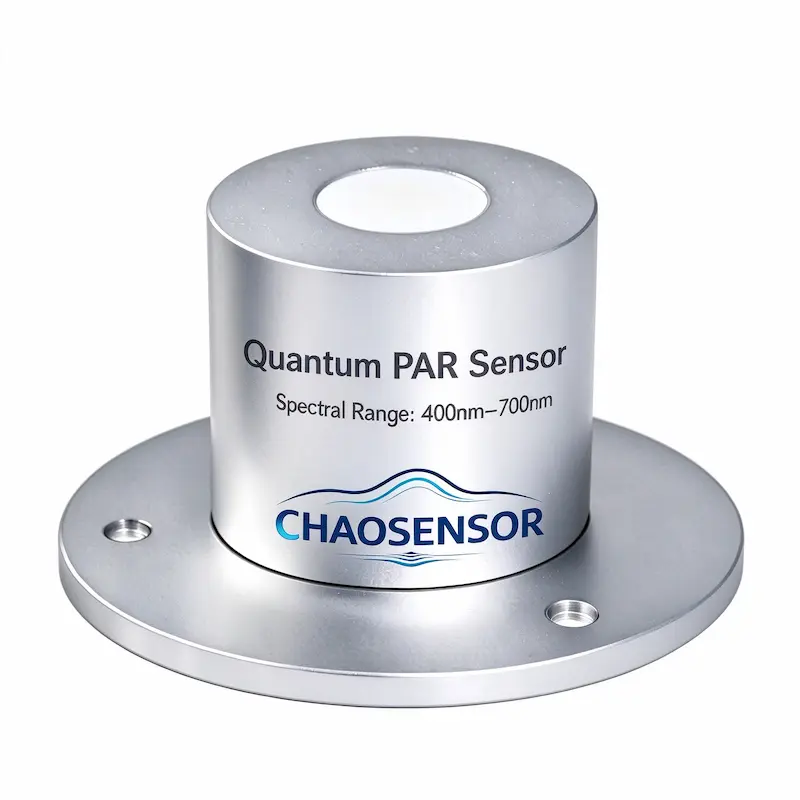
| Specification Parameter | Technical Details |
|---|---|
| Model / Series | CC-A-PAR Quantum PAR Sensor (CC-A Series) |
| Key Measurements Matrix | Photosynthetic Photon Flux Density (PPFD) & Solar Irradiance (400 – 700 nm PAR Waveband) |
| Optical & Quantum Radiation Matrix | |
| Measurement Range (Option A) | 0 – 2500 μmol/m²·s (Photosynthetic Photon Flux Density) |
| Measurement Range (Option B) | 0 – 2000 W/m² (Solar Irradiance Matrix) |
| Spectral Range | 400 – 700 nm (PAR Waveband) |
| Measurement Accuracy | ±5% rdg ± 10 digits | Non-linearity: < ±2% |
| Cosine Response & Speed | Cosine Response: ≤ 10% (At 80° solar zenith angle) | Response Time (95%): ≤ 1 s |
| Output Signal & Sensitivity Configurations | |
| Output Signal Options | 0 – 2000 mV / 4 – 20 mA / RS-485 (Modbus-RTU) |
| Voltage Output Sensitivity | PPFD Mode: 800 μV / (μmol/m²·s) | Irradiance Mode: 1000 μV / (W/m²) |
| Current Output Sensitivity | PPFD Mode: 6.4 μA / (μmol/m²·s) | Irradiance Mode: 0.8 μA / (W/m²) |
| RS-485 Protocol Defaults | Baud Rate: 9600 bps (1200–115200 bps configurable) | Frame: 8-N-1 | Default Slave ID: 09 (0x01–0xF7) |
| Electrical, Environmental & Mechanical Specifications | |
| Power Supply Voltage | 12 – 24 VDC (Standard), 3.3 VDC / 5 VDC (Optional) |
| Operating Environment | Temperature: -40 to +80 °C | Humidity: 0 – 100% RH (Non-condensing) |
| Housing Material & Dimensions | Anodized Aluminum Alloy (Marine-grade chassis) | Dimensions: Ø64 mm × H37 mm |
| Cable Length | 2 m / 3 m / 5 m standard options, or customized length upon request |
| Customization & Field Applications | |
| Tailored OEM/ODM Capability | • Brand Customization: Custom silk-screen or laser-engraved logo branding available. • Packaging Options: Private-label custom colored packaging designs. • Technical Adaptation: Fully customizable measurement ranges (PPFD / Irradiance), cable lengths, power supply options, and output signal configurations. |
| Applications | Precision agrometeorological tracking, commercial greenhouse automation, ecological research, atmospheric environmental monitoring, aquaculture systems, and advanced laboratory facilities. |
High-Precision Quantum PAR Sensor for Scientific and Industrial Use
The Chaosensor CC-A-PAR Quantum PAR Sensor is professionally designed to measure Photosynthetically Active Radiation (PAR) with exceptional accuracy. Operating across a critical spectral range of 400 to 700 nm, this advanced instrument quantifies the exact photon flux density that drives plant photosynthesis. Unlike ordinary light meters that simply measure visible brightness, this unit counts photons, delivering PPFD readings that directly relate to how much light chlorophyll can use for carbon fixation. Whether integrated into a commercial automated facility or used for academic botanical research, it provides stable, repeatable data that empowers growers and researchers alike to optimize plant growth environments and maximize crop yields.
Working Principle Behind the CC-A-PAR Quantum PAR Sensor
At its core, this Quantum PAR Sensor relies on a carefully filtered photodiode detector. The built-in optical filter blocks wavelengths outside the 400–700 nm band, ensuring only photons usable for photosynthesis reach the sensing element. Every unit leaves our factory individually calibrated against standard light sources, so the output reliably translates raw photocurrent into PPFD values. This photon-counting method is the industry standard for horticultural and ecological measurement, preferred over simple irradiance meters whenever you need to predict plant response rather than just measuring raw light energy.
Key Benefits of the CC-A-PAR Quantum PAR Sensor
Investing in a reliable Quantum PAR Sensor is essential for modern data-driven agriculture. Our sensor delivers an excellent cosine response of ≤10% at an 80° zenith angle, ensuring correct data collection even under low-angled morning or evening sunlight. Fast one-second response time means it captures rapid shifts caused by passing clouds or flickering grow lights without lag. Built with robust, weather-resistant materials, it offers long-term durability against high humidity, condensation, dust, and wide temperature swings common inside greenhouses and open farm sites. To explore more relevant monitoring equipment, feel free to browse our full collection of smart agriculture sensors to build a complete IoT environmental network.
Versatile Industrial Applications
This industrial-grade Quantum PAR Sensor seamlessly integrates with global smart farming protocols. Its versatile RS485 Modbus-RTU or analog (4-20mA) output interfaces allow easy connection with programmable logic controllers (PLCs), edge gateways, data loggers, and commercial weather stations. It is widely applied across multiple high-tech domains:
- Smart Greenhouse Automation: Dynamically adjusts supplementary LED grow lights and motorized shade screens based on real-time solar PPFD readings.
- Agritech & Precision Agriculture: Collects continuous microclimate data to evaluate crop canopy health, growth speed, and seasonal light availability.
- Botanical Photosynthesis Research: Delivers high-precision scientific inputs for university laboratories, plant physiology trials, and controlled growth-chamber experiments.
- Vertical Farms & Plant Factories: Maintains stable light recipes for leafy greens, herbs, and fruiting crops grown entirely under artificial illumination.
- Ecological Monitoring: Tracks natural light penetration through forest canopies, wetland vegetation, and native plant restoration plots.
By deploying our sensor, agricultural managers can gain complete transparency over their light environments, cut unnecessary lighting power costs, and reduce crop stress caused by over-lighting or insufficient photon supply. For deep scientific insights into how light wavelengths impact plant tissue development, you can consult authoritative studies on photosynthetically active radiation research published in international journals.
Installation and Maintenance Guidelines
Even the most accurate Quantum PAR Sensor will produce biased readings if mounted incorrectly. The sensing dome must sit perfectly level, with no shadows cast by pipes, shelving, lamp fixtures, or surrounding foliage. For canopy monitoring, install it at the same height as the target leaf layer. Keep the optical surface clean; dust, water spots, fertilizer residue, and algae buildup will lower measured PPFD gradually. A gentle wipe with a soft lint-free cloth every two to four weeks preserves measurement integrity and protects your long-term dataset.
Frequently Asked Questions
PPFD vs irradiance — what is the difference?
PPFD, the primary reading from this Quantum PAR Sensor, measures photon count in μmol/m²·s, the metric growers use to tune lighting recipes. Irradiance (W/m²) measures total light energy, which is useful for climate modelling but less direct for plant cultivation.
Can it read both sunlight and LED grow lights?
Yes. Thanks to its matched spectral filter, the sensor works reliably for natural daylight and common horticulture LED, HPS and ceramic metal halide lighting sources.