
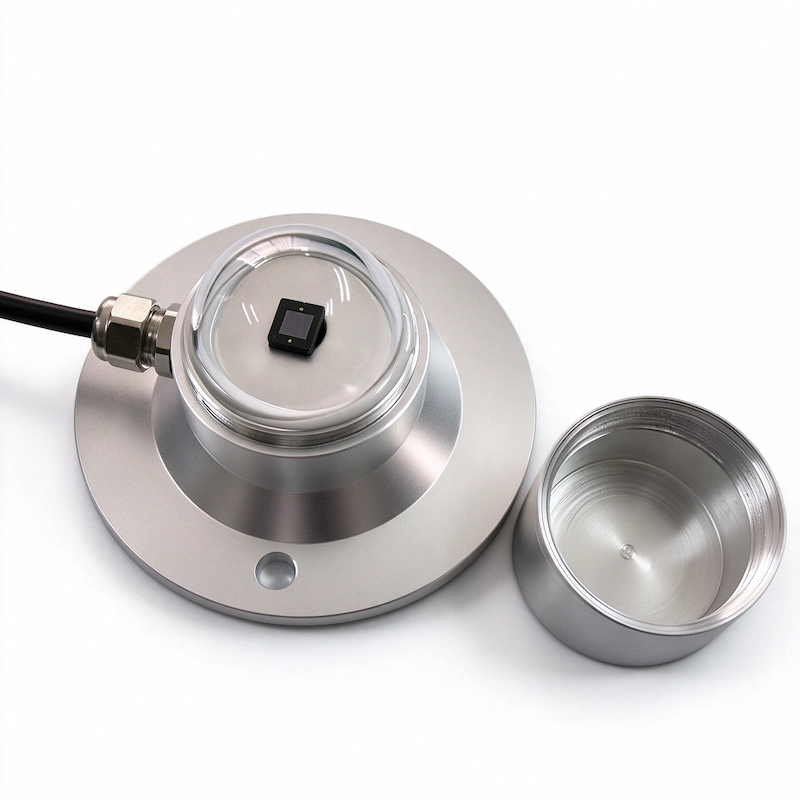
| Specification Parameter | Technical Details |
|---|---|
| Model | CC-S02 Pyranometer (Solar Irradiance Sensor) |
| Key Measurements | Solar Irradiance |
| Measurement Range | 0 – 1500 W/m² |
| Spectral Range | 300 – 1100 nm |
| Directional Response | ≤±10% |
| Non-linearity | ≤±2% |
| Response Time | ≤500 ns |
| Temperature Response | ≤±0.08%/°C |
| Operating Temperature | -40°C to +80°C |
| IP Rating | IP67 Waterproof |
| Enclosure Material | Anodized Aluminum Alloy |
| Mass Weight | 420 g |
| Optical Specification | Equipped with precision optical ground quartz glass dome |
| Output Signal | RS485 (Modbus-RTU) / 4 – 20 mA / 0 – 5 V / 0 – 2.5 V |
| Power Supply | 12 – 24 VDC (Std.) / 3.3 / 5 VDC (Opt.) |
| Cable Length | Fully customizable available upon request (Optional) |
| Tailored OEM/ODM Capability | Custom silk-screen or laser-engraved logo branding, tailor-made technical parameters and output signals, and private-label colored packaging designs. |
| Industrial Applications | Solar energy & PV power monitoring, agritech integration, professional meteorology stations, climate research, and smart environmental tracking. |
CC-S02 Pyranometer (Solar Irradiance Sensor) Overview
The CC-S02 Pyranometer (Solar Irradiance Sensor) is a high-performance photoelectric pyranometer built to capture accurate global horizontal irradiance for solar and meteorological projects. Unlike traditional thermopile pyranometers, this unit delivers ultra-fast readings with a response time of ≤500 ns, letting your system track rapid irradiance shifts caused by passing clouds and fast-changing sunlight. If you need reliable high-speed irradiance data for photovoltaic performance monitoring, this pyranometer provides a compact, rugged solution for long-term outdoor deployment. Built to withstand environmental extremes, the sensor operates flawlessly from -40°C to +80°C, ensuring stable irradiance logging for grid-scale PV infrastructure and research-grade weather stations. For comprehensive environmental asset monitoring, pair this pyranometer with our high-precision CC-M70 ultrasonic wind speed and direction sensors to eliminate all mechanical wear points on your weather station array. If you are looking for a cost-effective standard model with slower response, see our CC‑S01 Pyranometer (Solar Irradiance Sensor).
Advanced Engineering & Product Benefits
Why choose this high-speed pyranometer for commercial solar tracking and meteorological observation? Our design integrates high-end optical components with heavy-duty protection networks to guarantee stable, continuous outdoor irradiance data streams:
- Precision Optical Quartz Dome: Equipped with a ground quartz glass dome that optimizes light transmission across the 300 to 1100 nm spectral range, shielding the internal photoelectric sensing core of the pyranometer from dust, bird droppings, and heavy precipitation.
- Rugged Anodized Aluminum Alloy Enclosure: Featuring an IP67 waterproof-rated housing, the unit resists salt spray corrosion, severe ultraviolet exposure, and high-velocity wind loads in desert or coastal PV fields where reliable readings from a pyranometer are critical.
- Flexible Industrial Connectivity: Supports standard RS485 Modbus-RTU digital communication alongside versatile analog outputs (4-20 mA, 0-5 V, and 0-2.5 V) for seamless integration into existing SCADA systems, PLCs, and remote IoT edge gateways collecting measurements from this sensor.
Key Industrial Applications
The universal output flexibility and robust structural composition allow this pyranometer to serve numerous complex telemetry sectors globally:
- Solar PV Asset Performance Monitoring: Calculates real-time Performance Ratio (PR) metrics and diagnostic efficiency levels, assisting solar farm operators in identifying module soiling, inverter clipping, or solar array degradation by referencing live irradiance captured by the pyranometer.
- Professional Meteorological Networks: Delivers precise global solar irradiance inputs for synoptic automatic weather stations compliant with the World Meteorological Organization (WMO) structural and data consistency standards.
- Precision Smart Agriculture (AgTech): Empowers automated greenhouse climate controls, digital agronomy modeling, evapotranspiration calculation, and optimization setups for multi-crop commercial farms that rely on data gathered by this irradiance sensor.
- Urban Environmental Research: Assists smart city management networks in analyzing localized heat island effects, solar microclimate variations, and urban green-building design parameters using continuous irradiance measurements.
Professional On-Site Installation Guide
To ensure long-term measuring accuracy and maintain the specified ≤±2% non-linearity tolerance for your pyranometer, field technicians must adhere to strict installation protocols during system deployment:
- Perfect Horizontal Leveling: Utilize the integrated mechanical leveling feet and built-in bubble spirit level to secure the unit flatly on the crossarm mount, completely minimizing directional tracking bias for consistent irradiance readings.
- Shade-Free Alignment: Ensure that the quartz glass dome is entirely free from any structural obstructions, building margins, utility poles, trees, or surrounding weather sensors that could cast shadows and skew solar irradiance results at any hour of the day.
- Periodic Maintenance Routine: Regularly wipe down the optical quartz glass dome with a clean, damp lint-free cloth. Accumulated dust, sand, or winter frost can reflect incoming sunlight and cause undervalued irradiance logs.
Technical FAQ Highlights & Irradiance Terminology Clarifications
Understanding the strict data terminology differences helps engineering teams select the right pyranometer and optimize their environmental tracking arrays appropriately:
- What is the difference between Solar Irradiance and Solar Irradiation? Solar Irradiance refers to the instantaneous power of solar radiation per unit area, measured in Watts per square meter (W/m²), the exact value captured by our CC-S02 pyranometer. Conversely, Solar Irradiation represents the total accumulated radiant energy received over a specific time duration (such as hourly or daily totals), calculated via continuous mathematical integration over time as defined by ISO energy tracking metrics.
- How does the photoelectric response compare to standard thermopile alternatives? Photoelectric designs such as this one boast an incredibly rapid response time (≤500 ns) compared to thermopile models that require several seconds to register ambient thermal changes. This makes it uniquely suited for tracking fast cloud transitions and identifying immediate drop-offs in solar photovoltaic power generation.