
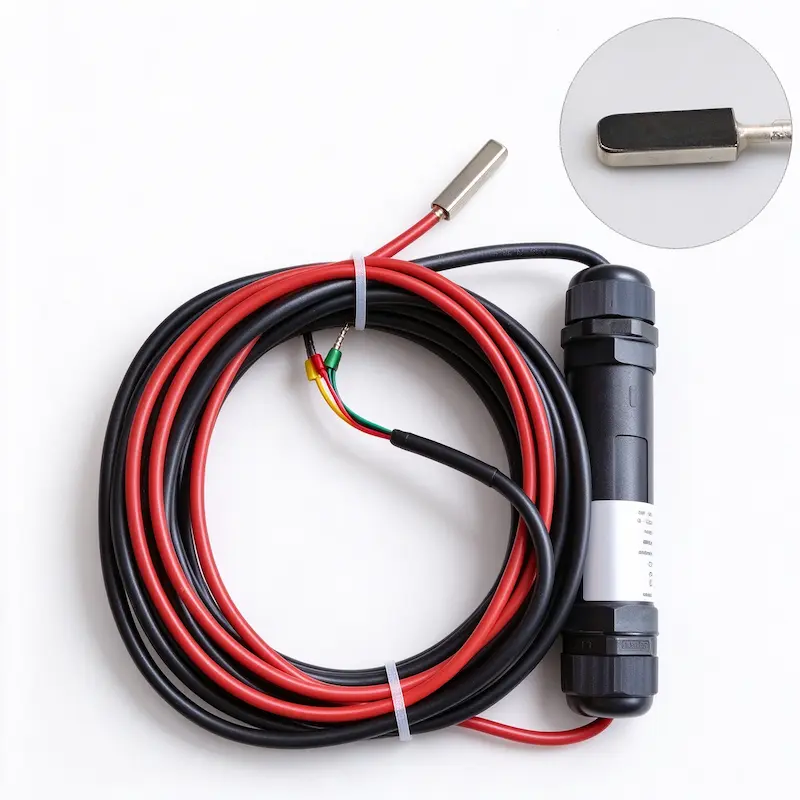
| Specification Parameter | Technical Details |
|---|---|
| Model / Series | CC-S08 Back-of-Module Temperature Sensor (CC-S Series) |
| Key Measurements Matrix | Photovoltaic (PV) Solar Module Rear-Surface Temperature (Resistive Thermometry) |
| Thermal Sensing & Accuracy Matrix | |
| Core Sensing Element | Class A Pt100 / Pt1000 Platinum RTD (Compliant with IEC 60751) |
| Measurement Range | -50 to +100 °C (Standard) | Optional: -50 to +150 °C / -50 to +200 °C |
| Measurement Accuracy | ±0.2 °C | Resolution: 0.1 °C (Default) / 0.01 °C (Configurable) |
| Stability & Self-Heating | Long-term Stability: ≤ 0.05 °C / year | Self-heating: ≤ 0.01 °C (at 1 mA excitation current) |
| Output Signal & Telemetry Configurations | |
| Output Signal Options | RS-485 (Modbus-RTU) / 4 – 20 mA / 0 – 5 V / 0 – 10 V |
| RS-485 Protocol Defaults | Baud Rate: 9600 bps (4800 / 9600 / 19200 bps configurable) | Frame: 8-N-1 | Default Slave ID: 01 (0x01–0xF7) |
| Power Supply Voltage | 12 – 24 VDC (Standard), 3.3 VDC / 5 VDC (Optional) |
| Environmental & Mechanical Configurations | |
| Operating Temperature | Probe Body: -50 to +100 / +150 / +200 °C | Transmitter Module: -50 to +85 °C |
| Ingress Protection (IP Rating) | IP67 Dust-tight & Waterproof (Ruggedized against sandstorms and moisture ingress) |
| Probe Design | Flat-surface thermally optimized housing for seamless back-of-module flush mounting |
| Cable Length Options | Dual-stage 6 m (1 m high-temp silicone lead + 5 m low-noise shielded tail) standard; 10 m / 20 m / 30 m / 50 m or custom length on request |
| Customization & Field Applications | |
| Tailored OEM/ODM Capability | • Brand Customization: Custom silk-screen or laser-engraved logo branding available. • Packaging Options: Private-label custom colored packaging designs. • Technical Adaptation: Fully customizable temperature ranges, RTD element types (Pt100/Pt1000), dual-stage cable lengths, and output signal configurations. |
| Applications | Utility-scale solar photovoltaic (PV) power plants, PV array efficiency tracking, cell degradation analytics, solar meteorological monitoring stations, and industrial surface temperature telemetry. |
The CC-S08 Back of Module Temperature Sensor is a high-precision, industrial-grade RTD instrument engineered explicitly for precise solar asset cell thermal logging inside utility-scale monitoring frameworks. For commercial photovoltaic operators, independent system developers, and asset managers, harvesting exact temperature metadata forms the prerequisite foundation for real-time performance ratio (PR) calculations, thermal degradation modeling, and structural system fault diagnosis. Built for multi-decade unattended field installations, this hardware solution empowers field engineers to maintain total visibility over their clean energy asset arrays globally.
1. Technical Architecture of the CC-S08 Back of Module Temperature Sensor
The core structural engineering integrated within the heavy-duty design of the CC-S08 Back of Module Temperature Sensor sets an industry-wide benchmark for professional solar cell tracking array networks. Photovoltaic panel efficiency undergoes noticeable linear drops as temperatures climb past standard test conditions (STC). Consequently, managing an accurate, reliable stream of panel backplane data forms the logical center for tracking unexpected power clipping and determining automated inverter safety responses. Deployed worldwide by independent system developers, commercial EPC contractors, and global financial auditors, tracking historical databases from this robust back of module temperature sensor provides uncompromised transparency needed to isolate structural equipment faults from natural solar resource fluctuations.
Modern industrial telemetry platforms require versatile hardware handshakes to ensure seamless multi-device array integration. The CC-S08 Back of Module Temperature Sensor natively supports digital RS485 Modbus-RTU communication protocols alongside legacy analog current and voltage configurations including 4-20 mA, 0-5 V, and 0-10 V loops. To maximize localized weather diagnostics across sprawling geographical generation sites, performance engineers can easily interlock this temperature device directly alongside our advanced CC-M70 ultrasonic wind speed and direction sensors, broadband double-dome pyranometers, and digital rain gauges to compile a high-performance weather monitoring hub.
2. Premium Platinum Chip Integration and Extreme Field Survivability
Eliminating measurement drift induced by intense, year-round environmental weathering is the primary hurdle when developing precision scientific instrumentation. To achieve our premium accuracy limit of ±0.2°C, this specialized hardware device utilizes a built-in premium world-renowned brand platinum thin-film chips element (PT100/PT1000 Class A). This core RTD sensor is encapsulated inside a low-profile, high-thermal-conductivity housing that maximizes surface area contact against the rear sheet of the solar module. This ensures rapid thermal transmission and near-instantaneous tracking of micro-climate panel temperature transitions.
Furthermore, standard commercial wiring cables easily crack under prolonged exposure to solar array heat traps. The CC-S08 Back of Module Temperature Sensor conquers this vulnerability by deploying an ultra-durable 1-meter high-temperature silicone lead connected to the core probe, capable of continuous structural operation under standard ranges extending up to 150°C or optional custom limits of 200°C. Backed by a fully sealed, integrated transmitter block that maintains exceptional signal integrity over extended 50-meter extensions, the entire sensor assembly carries a rugged IP67 rating, offering complete defense against intense ultraviolet breakdown, deep sub-zero freezing, and high-salinity marine air exposures.
3. Diverse Industrial Deployment Scenarios for Photovoltaic Asset Tracking
The strict industrial calibration of this professional back of module temperature sensor makes it an essential asset across multiple global sectors:
- Utility-Scale Solar Farms: Serving as the master thermal logging device needed to compute contract performance ratio (PR) formulas, cross-examine cell degradation, and validate panel manufacturer warranty metrics.
- Commercial and Industrial (C&I) Rooftop Arrays: Providing localized thermal signatures to monitor rooftop micro-climate heat traps, optimize string configuration layouts, and prevent localized safety hazards.
- State-Level Environmental Stations: Integrating into automatic meteorological networks demanding technical compliance with international WMO scientific observations.
- Independent Performance Auditing: Supplying bankable, high-fidelity empirical data required by independent engineers, financial institutions, and solar asset brokers during capital project validation and transaction due diligence.
4. Rigorous Installation Standards and Long-Term Field Maintenance
To lock in maximum baseline precision and prevent ambient airflow from distorting your data, the CC-S08 Back of Module Temperature Sensor must be adhered firmly using specialized industrial high-thermal-conductivity tape or structural adhesive. Technicians should position the flat face of the probe directly in the absolute geometric center of a selected cell on the rear backplane, ensuring you avoid internal busbars or panel structural cross-bracing that function as local heat sinks. Clean the mounting space thoroughly with isopropyl alcohol before application to guarantee long-term adhesion under extreme outdoor weather fluctuations.
Routine field maintenance is minor yet critical for structural database integrity. Field engineers should periodically inspect the physical bonding layer during routine site walks to ensure the sensor probe has not detached from the panel rear sheet due to thermal expansion cycles. Left unmanaged, a dangling sensor will measure ambient air temperatures rather than true cell heat indexes, introducing massive positive systematic errors that will distort your plant efficiency analytics according to international ISO validation frameworks.
5. Professional Frequently Asked Questions (FAQ)
Why should solar monitoring projects track back of module temperature instead of simple ambient air temperature?
Ambient air temperature provides a valuable general overview, but actual solar cells inside a sealed PV array absorb massive amounts of radiant energy, frequently running 20°C to 30°C hotter than the surrounding air. To calculate true electrical efficiency losses and track exact degradation curves, engineers must know the precise cell core temperature. Deploying a dedicated back of module temperature sensor is the only industrial standard recognized for collecting the localized baseline metrics required for bankable performance ratio math.
Does this industrial temperature hardware support customized register mapping for OEM frameworks?
Yes, absolutely. As a premier industrial hardware manufacturer, CHAOSENSOR provides full-scale technical OEM and ODM customization scaling. We can adjust the core internal transmitter parameters, supply custom ultra-low-noise shielding extensions to negate local inverter EMI noise, apply custom corporate branding logos, or provide customized Modbus address register tables to align flawlessly with your proprietary RTUs or remote SCADA field gateways.