
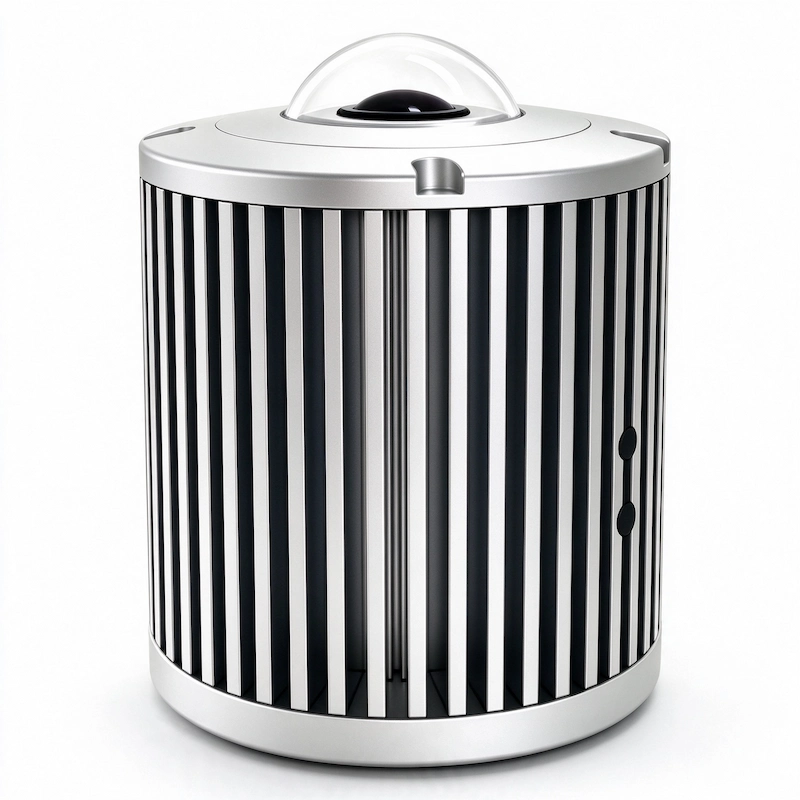
| Specification Parameter | Technical Details |
|---|---|
| Model | CC-S-CCAS Cloud Cover Assessment Sensor |
| Key Measurements | Cloud Cover Fraction (Total & Classified), Okta, Sky Condition, Solar Position |
| AI Intelligence | Large model algorithm driven for real-time cloud tracking & sky condition identification |
| Core Feature | High-precision optical sensing with telemetry visualization data tool |
| Cloud Fraction Output | Total Cloud Fraction (0 – 100%) | Okta Scale (0 – 8) |
| Sky Classification | Clear Sky (0 – 100%) | Few (0 – 100%) | Scattered (0 – 100%) | Broken (0 – 100%) | Overcast (0 – 100%) |
| System Status & Grade | Device Status (0 – 1) | Data Quality Grade (1 – 5) |
| Solar Position Metrics | Solar Elevation Angle (-90° – 90°) | Solar Azimuth Angle (0° – 360°) |
| Location Coordinate Outputs | Latitude (-90° – 90°) | Longitude (-180° – 180°) |
| Output Signal | RS485 (Modbus-RTU) |
| Power Supply | 12 VDC |
| Tailored OEM/ODM Capability | Custom silk-screen or laser-engraved logo branding, tailor-made technical parameters and output signals, and private-label colored packaging designs. |
| Industrial Applications | Advanced meteorological research, astronomical observation observatories, solar power grid loop & PV forecasting, nowcasting weather systems, and agrotech integration. |
CC‑S‑CCAS Cloud Cover Assessment Sensor
The CC‑S‑CCAS Cloud Cover Assessment Sensor is an AI‑empowered sky‑monitoring instrument built for objective cloud‑condition evaluation. This CC‑S‑CCAS Cloud Cover Assessment Sensor leverages large‑model algorithms to realize real‑time cloud tracking and sky‑scene identification. Combined with high‑precision optical sensing and telemetry visualization tools, the CC‑S‑CCAS Cloud Cover Assessment Sensor outputs total and classified cloud‑fraction data, Okta‑scale readings, multi‑level sky‑condition classification, alongside solar elevation, solar azimuth and geolocation coordinate information. It also provides device status and data‑quality grading for reliable traceable meteorological datasets.
Engineered for long‑term unmanned field deployment, the CC‑S‑CCAS Cloud Cover Assessment Sensor operates on standard 12 VDC power supply. All processed cloud‑related measurement data is transmitted through RS485 Modbus‑RTU digital bus for easy integration with data loggers, SCADA and forecasting platforms. The CC‑S‑CCAS Cloud Cover Assessment Sensor supports full OEM & ODM customization, including custom logo marking, adjusted output parameters and private‑label packaging to satisfy integrator‑specific project requirements.
For solar‑grid operation, astronomical observatories and meteorological institutions, subjective manual cloud observation brings inconsistency and human‑caused deviation. The CC‑S‑CCAS Cloud Cover Assessment Sensor converts visual sky conditions into standardized quantitative metrics. Whether for short‑term PV power nowcasting, advanced climatology research or agrotech‑related meteorological integration, the CC‑S‑CCAS Cloud Cover Assessment Sensor delivers stable classified cloud‑cover results under diverse outdoor weather conditions.
Typical Applications
- Solar‑grid operation and photovoltaic short‑term power forecasting
- Professional meteorological research and weather nowcasting systems
- Astronomical observatory automatic sky‑condition monitoring
- Agrotech and agricultural‑meteorology integration projects
- Renewable‑energy meteorological observation networks
Core Advantages & Product Selection Guide
The CC‑S‑CCAS Cloud Cover Assessment Sensor brings AI‑based intelligent cloud classification to replace traditional subjective manual observation. If you require panoramic whole‑sky imaging together with cloud‑cover analysis, pair this sensor with our CC‑S‑ASI All‑Sky Imager. Discover more solar‑monitoring instruments in our solar PV monitoring sensors collection.