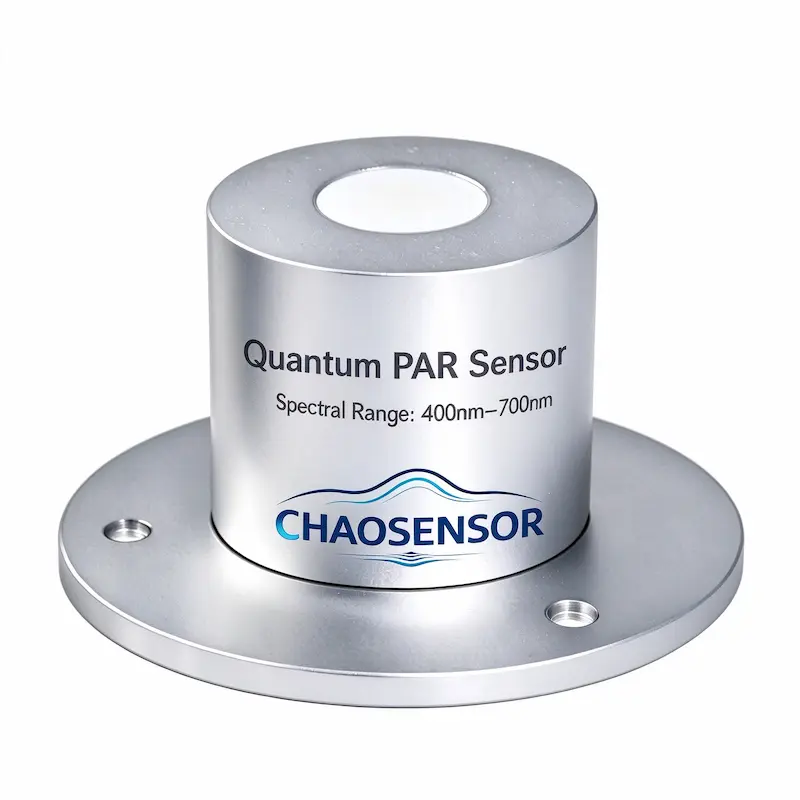
What Exactly Is PAR (Photosynthetically Active Radiation)?
Photosynthetically Active Radiation (PAR) defines the range of light photons that plants can utilise to drive photosynthesis, converting carbon dioxide and water into biomass, sugars and crop yields.
Unlike human‑oriented lux meters which measure perceived brightness, quantum PAR sensors count photons, reporting PPFD (Photosynthetic Photon Flux Density) in μmol/m²·s — the standard metric for horticulture, vertical farming and plant science research.
The globally‑accepted standard spectral window for PAR measurement is 400 nm to 700 nm. But why this exact band, rather than broader or narrower wavelengths?
Why 400‑700 nm — The Biological Foundation
Plant photosynthesis relies on chlorophyll‑a, chlorophyll‑b and accessory carotenoid pigments inside leaf chloroplasts. These pigments strongly absorb blue light (~400‑500 nm) and red light (~600‑700 nm), while reflecting most green light, which gives plants their characteristic green appearance.
– Below 400 nm (UV): Short‑wavelength ultraviolet photons carry high energy; they can damage plant cell DNA rather than contributing positively to carbon fixation. While UV influences plant morphology, it is not counted for core photosynthetic yield.
– 400‑700 nm: Photons within this band deliver the correct energy level to trigger photochemical reactions in photosystem I and II. This action‑spectrum boundary was formalised by decades of plant physiology research (McCree, 1972), becoming the universal industry standard for quantum‑type PAR sensors.
– Above 700 nm (Far‑red / Infrared): Far‑red photons (>700 nm) have low standalone photosynthetic efficiency. Though modern research notes synergistic canopy effects for 700‑750 nm far‑red light, they are excluded from classic PAR definitions, as they cannot independently drive photosynthesis at meaningful rates.
Note: Extended‑PAR (e‑PAR, 400‑750 nm) is discussed in advanced research papers, yet nearly all commercial greenhouse and research installations still adopt the established 400‑700 nm specification for consistent, comparable PPFD measurements.
Why Sensor Optical Filters Must Match the 400‑700 nm PAR Band
A quantum PAR sensor uses precision optical filters paired with a photodiode detector. The filter physically blocks all photons outside 400‑700 nm, ensuring only photosynthetic‑useful photons reach the detector chip.
If a sensor lacks accurate spectral filtering:
1. UV or infrared noise contaminates readings;
2. PPFD values drift when switching between sunlight, HPS, or LED grow lights;
3. Your light‑recipe tuning, yield forecasting and research datasets become unreliable.
Not all PAR sensors deliver consistent spectral fidelity. When evaluating hardware, check for factory individual calibration, cosine response performance, and output options for your control system.
The Chaosensor CC‑A‑PAR Quantum PAR Sensor is engineered strictly for the 400‑700 nm PAR spectral range, factory‑calibrated for either PPFD (0–2500 μmol/m²·s) or irradiance output, selectable on setup. It supports RS485 Modbus‑RTU and multiple analog outputs (4‑20 mA, 0‑2 V, 0‑5 V), making it suitable for greenhouses, vertical farms, plant physiology labs and agrometeorological stations.
Key Technical Specifications to Compare When Choosing a PAR Sensor
Understanding the 400‑700 nm principle is only half the work; real‑world performance depends on extra critical parameters:
1. Cosine response: How accurately the sensor reads light coming from low sun‑angles (morning / evening sunlight). Look for ≤10 % error at 80° zenith angle, as featured by the CC‑A‑PAR. Poor cosine response creates large under‑readings in field conditions.
2. Non‑linearity & accuracy: Guarantees stable readings across low‑light seedling environments up to full summer sunlight.
3. Response time: ≤1 second captures fast light fluctuations caused by cloud movement or flickering grow lamps.
4. Signal output: Match to your PLC, data‑logger or IoT gateway: Modbus‑RTU for multi‑sensor networks, analog for legacy automation hardware. Remember that PPFD and irradiance are mutually exclusive output selections on this model.
5. Environmental durability: Weather‑proof construction to resist humidity, dust and temperature swings in greenhouses and open‑field sites.
Common Misconceptions: PPFD vs Irradiance (W/m²)
Many buyers confuse PPFD and irradiance:
– PPFD (μmol/m²·s): Photon count across 400‑700 nm — this is what growers and plant scientists use to adjust lighting recipes for plant photosynthesis.
– Irradiance (W/m²): Measures total light energy, useful for climate modelling but cannot directly predict plant growth response.
The CC‑A‑PAR Quantum PAR Sensor supports PPFD or irradiance output, selectable by configuration; the two readings cannot be streamed out at the same time. Users can pick the metric that best fits their control or logging workflow.
Practical Deployment Tips for 400‑700 nm PAR Measurement
Even the best‑specified sensor will produce biased data with poor installation:
1. Mount the sensing dome perfectly level; avoid shadows from beams, lamps or foliage.
2. For crop‑canopy monitoring, install the sensor at target leaf‑layer height.
3. Keep the optical dome clean: dust, fertiliser residue or algae will attenuate 400‑700 nm incoming photons and lower PPFD measurements. Wipe gently every 2‑4 weeks with a lint‑free soft cloth.
4. Verify calibration status for long‑term research projects.
Frequently Asked Questions
Do PAR sensors work for both natural sunlight and LED grow lights?
Yes — as long as the sensor has properly matched 400‑700 nm optical filtering. The CC‑A‑PAR Quantum PAR Sensor works reliably for sunlight, HPS, ceramic MH and modern horticulture LED lighting systems.
Should I buy an extended‑PAR 400‑750 nm sensor for my greenhouse?
For most commercial growing operations, stick to the standard 400‑700 nm quantum PAR sensor. The 400‑750 nm extended‑PAR concept remains mostly for academic research; using non‑standard hardware will make it harder to cross‑reference against established crop light‑recipe literature.
What applications require a high‑precision quantum PAR sensor?
Smart greenhouse automation, vertical plant factories, university plant physiology trials, crop‑canopy micro‑climate monitoring and ecological forest‑light penetration surveys.
Final Takeaway
The 400‑700 nm spectral range is not arbitrary: it represents the photon energy window where plant chlorophyll pigments efficiently perform photosynthesis. Your PAR sensor’s optical filter must faithfully replicate this band to deliver trustworthy PPFD numbers for optimising light recipes, reducing energy waste and maximising crop yields.
If you are sourcing an industrial or research‑grade quantum PAR sensor, explore the CC‑A‑PAR Quantum PAR Sensor.