
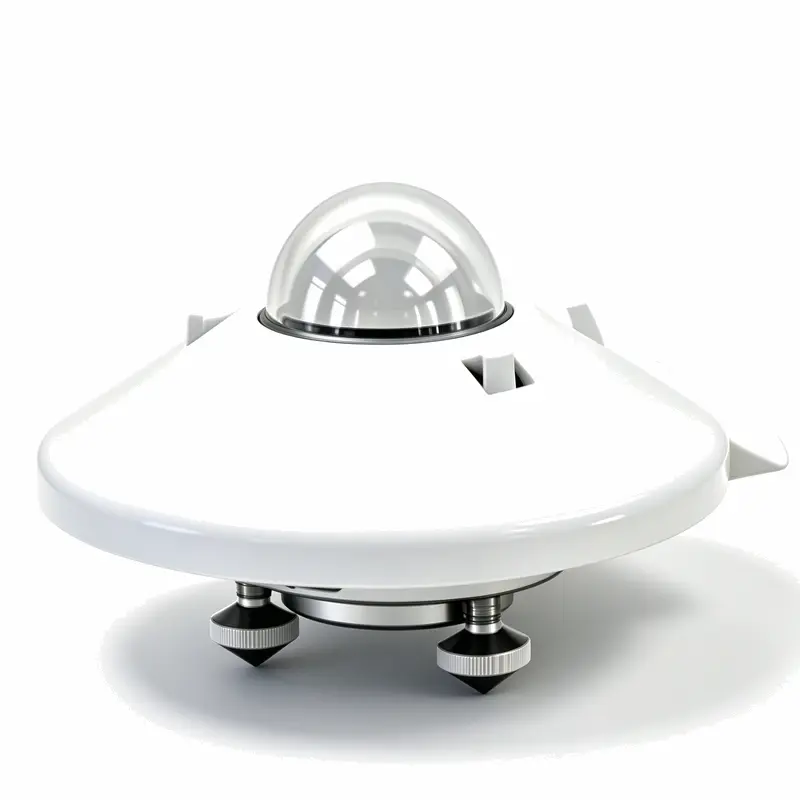
A pyranometer is a radiometric instrument designed to measure global horizontal irradiance (GHI), the total solar energy arriving on a horizontal surface from the entire sky dome. Widely used for photovoltaic performance monitoring, meteorological stations, solar resource assessment and climate research, pyranometers are commonly grouped by sensing principle and by the official ISO 9060 classification standard.
Two Main Types by Sensing Technology
Thermopile Pyranometer
A thermopile pyranometer uses a black absorbing surface connected to a thermopile. Sunlight heats the absorber, and the temperature difference generates a voltage proportional to irradiance. This design captures a broadband solar spectrum, typically from roughly 280 nm to 3000 nm, making it the preferred choice when true absolute solar irradiance is required.
High‑grade thermopile pyranometers feature double quartz domes to reduce thermal offset and protect the sensing core. They are traceable to the World Radiometric Reference (WRR) and can meet strict requirements for BSRN‑compliant reference stations and third‑party PV performance audits.
Our CC‑S13 Class‑A Pyranometer represents the top tier, while the CC‑S05 Class‑B Thermopile Pyranometer delivers reliable, cost‑effective broadband measurement for routine solar monitoring.
Silicon Photodiode Pyranometer
A silicon pyranometer uses a photovoltaic cell as the detector. It responds mainly to visible and near‑infrared light, matching the spectral response of typical PV modules. It is fast, compact and lower cost, well suited for distributed solar farms where relative irradiance tracking is more important than absolute reference measurement.
Because it does not cover the full solar spectrum, it is not normally accepted for high‑level reference meteorology or formal bank‑grade solar resource assessment. The CC‑S02 Class‑C Pyranometer is our silicon‑based option for economical field deployment.
ISO 9060 Classification: Class A, Class B and Class C
ISO 9060 is the global standard for pyranometer performance. The updated ISO 9060:2018 replaced the older naming scheme: secondary standard, first class and second class, with Class A, Class B and Class C.
- Class A (Spectrally Flat): Highest performance, with tight limits on spectral error, directional response, temperature drift and long‑term stability. Required for BSRN‑grade radiation stations, climate research and independent PV acceptance testing. CC‑S13 belongs to this category.
- Class B: Mid‑tier thermopile pyranometer, ideal for most utility‑scale PV monitoring networks, meteorological stations and regular performance audits. CC‑S05 is our Class‑B thermopile model.
- Class C: Entry‑level irradiance sensor, usually silicon type. Best for low‑cost distributed solar sites and general environmental monitoring where strict reference‑grade accuracy is not mandatory. CC‑S02 is our Class‑C option.
Other Related Solar Radiometers
While “pyranometer” generally refers to GHI sensors, you will often see them paired with other radiometric instruments:
- Pyrheliometer: Measures direct normal irradiance (DNI) through a narrow field of view, usually mounted on an automatic sun tracker.
- Albedo sensor: A downward‑facing pyranometer used to measure reflected solar radiation from the ground.
How to Pick the Right Pyranometer
If you need reference‑quality data for financing, third‑party verification or climate research, select a Class‑A thermopile pyranometer such as the CC‑S13. For standard PV plant monitoring and meteorological networks, a Class‑B thermopile pyranometer like the CC‑S05 offers the best balance of accuracy and budget. If you only need affordable relative irradiance logging for many distributed solar sites, the Class‑C silicon pyranometer CC‑S02 is a practical choice.
All CHAOSENSOR pyranometers are calibrated in our in‑house calibration laboratory and support industrial outputs including RS485 Modbus‑RTU, 4‑20 mA and 0‑5 V for integration with weather stations, SCADA and IIoT cloud platforms.
Frequently Asked Questions
Is a thermopile pyranometer always better than a silicon pyranometer?
Not always. Thermopile sensors deliver true broadband irradiance, but they cost more. Silicon pyranometers are faster and cheaper; they work very well for relative PV monitoring when the project does not require WRR‑traceable absolute measurement.
Do I need Class A for a normal solar farm?
Most utility PV plants use Class‑B pyranometers for routine performance monitoring. Class A is reserved for reference stations, bank‑financed resource surveys and formal third‑party performance validation.
How often should a pyranometer be recalibrated?
For Class‑A reference instruments, a two‑year recalibration cycle is recommended to maintain traceable accuracy. Class‑B and Class‑C sensors should also be recalibrated periodically according to project and audit requirements.