
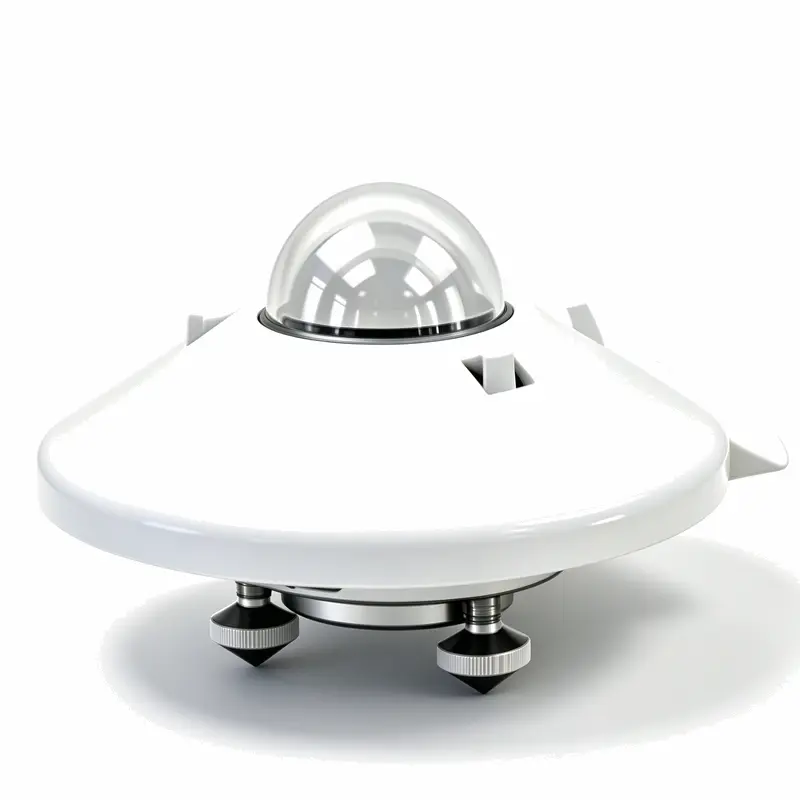
| Specification Parameter | Technical Details |
|---|---|
| Model / Series | CC-S13 Pyranometer / Solar Irradiance Sensor (CC-S Series) |
| ISO 9060 / WMO Classification | Class A (Spectrally Flat) |
| Measurement Principle | Passive Blackened Thermopile with Double Quartz Dome |
| Radiometric & ISO 9060 Performance Specifications | |
| Maximum Operational Irradiance | 0 to 4000 W/m² |
| Spectral Range (50% Points) | 280 to 3000 nm |
| Sensitivity | 7 to 14 µV/(W/m²) (Individual calibration factor supplied on certificate) |
| Response Time (95%) | < 5 s |
| Zero Offset (200 W/m² Net Thermal) | < 7 W/m² (Ventilated) |
| Non-stability (Annual Drift) | ±0.5% per year (of full scale) |
| Non-linearity | ±0.2% (100 to 1000 W/m²) |
| Directional Response | ±10 W/m² (for 1000 W/m² beam) |
| Temperature Response | < 1% (-10°C to +40°C) |
| Tilt Response | < 0.5% |
| Daily Exposure Uncertainty | ±1% |
| Calibration Traceability & Interval | World Radiometric Reference (WRR) per ISO 9847 | Recommended 2-year recalibration cycle |
| Electrical, Communication & Mechanical Configurations | |
| Output Signal Options | • Passive Analog: 0 to 20 mV (Typical atmospheric applications: 0 to 1500 W/m²; up to 56 mV at 4000 W/m²) • Digital Interface: RS485 (Modbus-RTU, 4800–115200 bps, default 9600 bps, Address 1–247) • Current Loop: 4 to 20 mA (Default scaled to 0–2000 W/m² via external/inline converter) |
| Internal Resistance | < 50 Ω (Passive thermopile circuit) |
| Power Supply & Consumption | Passive (No power required for mV output) | 6 to 30 VDC, 0.18 W (for RS485 & 4–20 mA versions) |
| Operating Temperature | -40°C to +80°C |
| Ingress Protection & Construction | IP67 Sealed Housing | 1 mm Double Quartz Domes | Integrated Bubble Level & Three Point-Contact Levelling Feet |
| Dimensions & Weight | Body Diameter: Ø150 mm | Dome Diameter: Ø92 mm | Overall Height: 93 mm | Foot Circle: Ø120 mm | Weight: 0.55 kg (excluding cable) |
| Cable Length | 3 m standard user-replaceable shielded cable (Customizable lengths available upon request) |
| Tailored OEM/ODM Capability | • Brand Customization: Custom silk-screen or laser-engraved logo branding available. • Packaging Options: Private-label custom protective packaging and calibration certificates. • Technical Adaptation: Customizable output scaling ranges (e.g., 4–20 mA span), cable lengths, and ventilation/heating accessories. |
| Applications | Meteorological observation networks, solar PV power plant performance monitoring, agricultural & evapotranspiration modeling, climate research, and building physics studies. |
CC‑S13 Class‑A Pyranometer (Solar Irradiance Sensor) Overview
The CC‑S13 Class‑A Pyranometer is an ISO 9060:2018 Spectrally‑Flat Class‑A thermopile‑type pyranometer built for highest‑grade global‑horizontal‑irradiance measurement for meteorology, reference‑grade radiation stations and premium photovoltaic performance audits. Adopting passive blackened thermopile sensing element protected by precision double quartz domes, it captures true broadband solar radiation across 280‑3000 nm spectrum. Each CC‑S13 instrument is calibrated inside CHAOSENSOR’s in‑house calibration laboratory with full traceability to the World Radiometric Reference (WRR) per ISO 9847 standard, delivering authoritative measurement quality for BSRN‑compliant observation sites and third‑party PV‑performance verification. Built to withstand environmental extremes, the sensor operates reliably from -40°C to +80°C for long‑term unattended outdoor deployment. For comprehensive environmental asset monitoring, pair this pyranometer with our high‑precision CC‑M70 ultrasonic wind speed and direction sensors to eliminate mechanical wear‑points on your weather‑station array. For mid‑tier ISO 9060 Class‑B thermopile model, please review CC‑S05 Thermopile Pyranometer. If you are seeking cost‑effective Class‑C photoelectric irradiance sensor, refer to CC‑S02 Pyranometer (Solar Irradiance Sensor).
Advanced Engineering & Product Benefits
Why choose this Spectrally‑Flat Class‑A thermopile pyranometer for reference‑grade meteorological observation and high‑stakes PV‑performance auditing? Our design integrates premium‑grade optical components together with heavy‑duty protection networks to guarantee stable, traceable outdoor irradiance‑data streams:
- Dual‑Layer High‑Precision Optical Quartz Domes: 1 mm‑thick double quartz‑glass domes optimize uniform broadband light transmission covering 280‑3000 nm spectral range, shielding the internal blackened thermopile sensing core from dust, bird droppings, heavy precipitation and dew‑condensation interference.
- Integrated Precision‑Leveling Mechanism: Built‑in bubble spirit level plus three‑point‑contact adjustable levelling feet simplify accurate horizontal installation, minimizing directional‑response error for high‑accuracy hemispherical radiation capture.
- WRR‑Traceable In‑House Calibration: Every single CC‑S13 unit receives traceable calibration inside CHAOSENSOR’s own calibration laboratory. Individual calibration certificate is supplied for meteorological archives, BSRN‑station qualification and PV‑audit documentation requirements. Recommended recalibration cycle is every 2 years.
- Multi‑Mode Flexible Industrial Connectivity: Supports passive mV analog output, 4‑20 mA current‑loop and RS485 Modbus‑RTU digital communication, for seamless integration into high‑end data‑loggers, SCADA systems, PLCs and professional meteorological‑station edge‑gateways.
- Rugged IP67 Anodized‑Aluminum Housing: Sealed heavy‑duty enclosure resists salt‑spray corrosion, intense UV exposure and high‑velocity wind‑loads for desert, coastal and alpine long‑term field deployment.
Key Industrial Applications
The authoritative measurement performance and universal‑output flexibility allow this reference‑grade pyranometer to serve numerous high‑level telemetry‑sectors globally:
- BSRN‑Grade Meteorological Observation Networks: Delivers WRR‑traceable global‑horizontal‑irradiance data for baseline‑surface‑radiation‑network‑level scientific meteorological monitoring and climate‑change research.
- High‑Precision Solar‑PV Asset‑Performance Auditing: Provides reference‑quality irradiance inputs for third‑party independent PV‑performance‑ratio (PR) verification, utility‑scale solar‑farm acceptance testing and solar‑resource bank‑financing assessment.
- Pre‑Construction High‑Grade Solar‑Resource Assessment: Deployed for authoritative on‑site solar‑resource survey before constructing large‑scale photovoltaic and concentrating‑solar‑power‑plants.
- Agri‑voltaic & Evapotranspiration Research: Supports high‑accuracy radiation monitoring for agrivoltaic projects, reference‑grade greenhouse‑climate modelling and regional evapotranspiration‑calculation research.
- Building‑Physics & Environmental‑Climate Research: Applied for authoritative short‑wave‑radiation observation for building‑energy‑simulation, urban‑micro‑climate and outdoor environmental‑research projects.
Professional On‑Site Installation Guide
To preserve Class‑A measurement performance and maintain full‑spec accuracy for your CC‑S13 pyranometer, field technicians must adhere to strict installation‑protocols during system‑deployment:
- Strict Horizontal Leveling: Utilize the integrated bubble spirit‑level and three‑point adjustable levelling feet to achieve perfect horizontal mounting on rigid crossarm structure; any tilt will introduce measurable directional‑response deviation for reference‑grade measurement.
- Full Shade‑Free Alignment: Ensure double quartz domes are completely free from obstructions: building edges, utility‑poles, trees, nearby weather‑sensors or support‑hardware that can cast shadows and corrupt hemispherical irradiance readings across all solar‑elevation angles throughout day‑time.
- Periodic‑Maintenance Routine: Regularly wipe outer quartz‑glass dome surface with clean damp lint‑free cloth. Accumulated dust, sand, frost or salt deposits degrade optical transmission and will generate low‑biased irradiance measurement results for reference‑station datasets.
- Calibration‑Cycle Management: Follow the recommended 2‑year recalibration cycle; send instrument back to CHAOSENSOR calibration‑lab for WRR‑traceable recalibration to sustain Class‑A metrological performance over multi‑year field service.
Technical FAQ Highlights & Irradiance Terminology Clarifications
Understanding strict‑data‑terminology differences helps engineering‑teams select appropriate pyranometer grade and optimize high‑precision environmental‑tracking‑arrays appropriately:
- What is Spectrally‑Flat Class‑A per ISO 9060:2018? Spectrally‑Flat Class‑A represents the highest performance tier under current ISO 9060:2018 standard (old‑name secondary‑standard). It imposes tight limits on spectral‑error, directional‑response, temperature‑drift and long‑term stability; required for BSRN‑level meteorology and independent third‑party PV‑performance acceptance audits. Compare with Class‑B CC‑S05 and Class‑C CC‑S02 for project‑grade selection.
- Why WRR‑traceable calibration matters? WRR (World Radiometric Reference) is the global WMO‑endorsed solar‑radiation measurement reference standard. Traceability to WRR guarantees your pyranometer measurement results are internationally comparable for scientific publication, meteorological‑network data exchange and formal PV‑project audit‑report documentation.
- What is the difference between Solar Irradiance and Solar Irradiation? Solar Irradiance refers to instantaneous‑power of solar‑radiation per unit‑area, measured in Watts per square‑meter (W/m²), the exact value captured by our CC‑S13 pyranometer. Conversely, Solar Irradiation represents total‑accumulated radiant‑energy received over a specific‑time‑duration (such as hourly or daily totals), calculated via continuous‑mathematical‑integration over time as defined by ISO energy‑tracking metrics.