
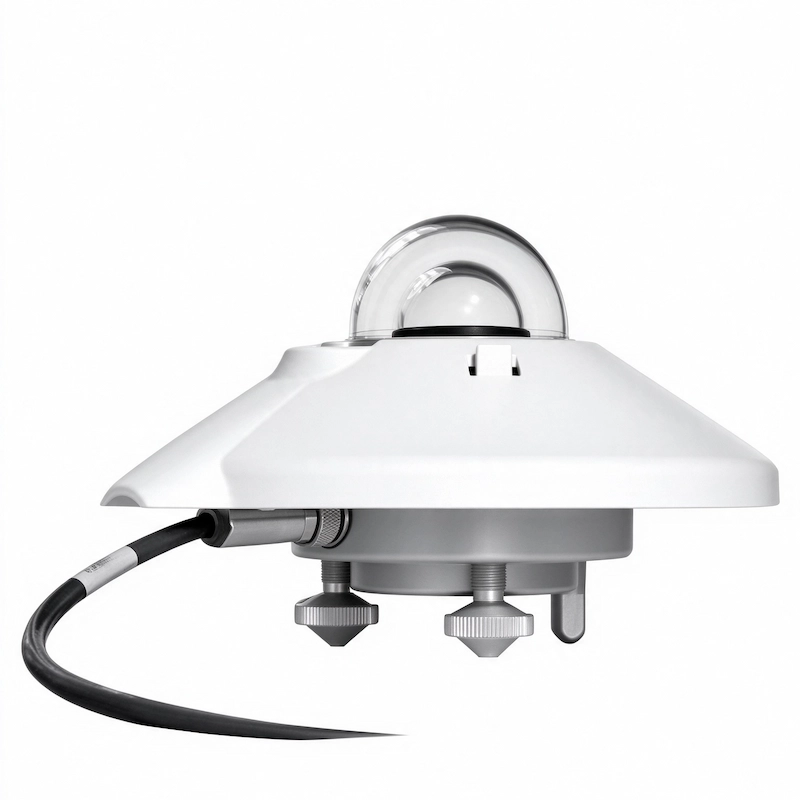
The CC-S05 Thermopile Pyranometer (Solar Irradiance Sensor) is a scientific-grade radiometer specifically engineered for precise broad-spectrum solar irradiance tracking. For commercial photovoltaic utility operators, meteorological system integrators, and independent environmental research institutions, gathering uncompromised solar radiation data forms the foundation of calculated plant efficiency, resource mapping, and structural fault diagnosis. Built for multi-decade unattended field placement, this instrument enables engineering teams to maintain total visibility over their critical clean energy monitoring systems.
| Specification Parameter | Technical Details |
|---|---|
| Model | CC-S05 Pyranometer (Solar Irradiance Sensor) |
| Key Measurements | Solar Irradiance |
| Measurement Principle | High-stability Thermoelectric Pile sensor technology |
| Measurement Range | 0 – 2000 W/m² |
| Spectral Range | 280 – 3000 nm (Broadband Solar Spectrum) |
| Response Time | < 10 seconds (95% response propagation) |
| Non-linear Error | ±1% |
| Optical Specification | Double spherical quartz glass domes to drastically reduce thermal offset variables |
| Leveling Hardware | Built-in internal leveling bubble and adjustable feet |
| Output Signal | RS485 (Modbus-RTU) / 4 – 20 mA / 0 – 5 V |
| Power Supply | 12 – 24 VDC (Std.) / 3.3 / 5 VDC (Opt.) |
| Cable Length | Fully customizable available upon request (Optional) |
| Tailored OEM/ODM Capability | Custom silk-screen or laser-engraved corporate logo branding, tailor-made technical parameters, altered output signals, and private-label colored packaging designs. |
| Industrial Applications | Solar energy & PV power plant monitoring, solar tracking systems, agritech integration, professional meteorology stations, climate research, and smart environmental tracking. |
1. Scientific Infrastructure of the CC-S05 Thermopile Pyranometer
The premium engineering behind the CC-S05 Thermopile Pyranometer (Solar Irradiance Sensor) sets an industry standard for professional outdoor solar tracking array networks. Utilizing a broadband thermoelectric pile sensor collector, this device tracks total solar radiation power flux across an extensive 280 to 3000 nm spectral window. Unlike consumer-grade photodiode light meters, this industrial thermopile pyranometer absorbs incoming sunlight across all wavelengths, rendering it highly resilient to spectral selectivity shifts. Deployed worldwide by independent system developers, state utility corporations, and financial auditors, harvesting accurate irradiance logs from this instrument forms the mandatory core for calculated performance ratio (PR) indices and contract yield verifications.
Modern industrial telemetry platforms require versatile hardware handshakes to ensure reliable field integration. This smart sensing device natively supports digital RS485 Modbus-RTU multi-drop configurations alongside conventional analog current loops, including 4-20 mA and 0-5 V. To maximize weather diagnostic capacity across expansive geographical sites, system integrators can easily interlock this device alongside our advanced CC-M70 ultrasonic wind speed and direction sensors, aspirated temperature-humidity louvers, and barometric air pressure cells to construct a complete, utility-ready meteorological observation hub.
2. Premium Optical Engineering and Reduced Thermal Offset
Eliminating micro-climate measurement drift is the primary hurdle when developing precision scientific instrumentation. The core of this premium thermopile pyranometer features a heavy-duty, double spherical quartz glass dome configuration. This dual-dome architectural wall acts as a strict thermal barrier, insulating the inner black absorber coating from ambient long-wave infrared (IR) environmental radiation exchanges. This double quartz design drastically cuts off negative thermal offset anomalies, securing an exceptionally tight non-linear error threshold within ±1%, regardless of rapid cloud shading transitions or intense ambient wind chill factors.
Furthermore, maintaining interior cavity equilibrium is critical for long-term field survivability. The chassis contains built-in physical desiccant dryer slots that actively draw out trapped humidity, ensuring the internal components remain dry and preventing internal frost or lens condensation from scattering the optical light paths. Encased in a rugged IP67 weather-proof body with an integrated solar radiation shield jacket, the device continues to log critical telemetry across extreme industrial temperature limits ranging from -40°C up to +80°C without technical failure or premature physical housing aging.
3. Diverse Industrial Applications for Broad-Spectrum Radiometers
The strict lab-grade calibration of this commercial radiometer makes it an essential hardware component across multiple global sectors:
- Utility-Scale Photovoltaic Asset Operations: Providing the master baseline data needed to identify sub-string inverter clipping anomalies, tracking tracker tilt accuracy, and documenting weather degradation.
- Synoptic Weather Observation Networks: Deployable within state-level automatic weather stations demanding strict technical compliance with international WMO scientific guidelines.
- Commercial Agritech and Greenhouse Telemetry: Monitoring the total broadband solar energy index required to model crop evapotranspiration coefficients and conduct precise plant growth analysis.
- Renewable Greenfield Solar Farm Prospecting: Furnishing bankable, high-fidelity historical solar resource data for financial institutions and sovereign funds ahead of capital project financing.
- Smart-City Environmental tracking: Correlating urban heat-island climate dynamics, mapping micro-grid potential matrices, and checking automated green roof insulation layers.
4. Rigorous Field Installation and Long-Term On-Site Maintenance Guidelines
To lock in maximum measurement stability and wipe out systematic directional tracking errors, the mounting platform must be oriented perfectly flat. Technicians must leverage the built-in leveling feet and integrated high-visibility circular bubble level indicator located on the heavy-duty mounting plate during the structural calibration process. Ensure that the surrounding hemisphere remains entirely clear of obstructions; nearby utility poles, safety fencing, or growing tree branches must not cast shadow lines onto the double spherical quartz glass domes at any hour of the solar path.
Routine physical care is straightforward yet absolutely vital for overall historical database integrity. Maintenance engineers should thoroughly wipe the outer quartz dome surface clean of dust, wind-blown industrial grime, or bird droppings using a non-abrasive microfiber cloth moistened with deionized water once a month. Left unmanaged, glass dome contamination introduces severe systematic measurement deviation that can distort your overall solar harvest records over multi-year operational cycles.
5. Professional Frequently Asked Questions (FAQ)
What distinct physical properties set a thermopile pyranometer apart from a standard photodiode sensor?
A thermopile pyranometer utilizes a thermal-pile detection method that responds uniformly across the full solar spectrum (280 to 3000 nm), capturing both short-wave and long-wave solar fluxes. Standard photodiode sensors feature limited spectral response windows, often missing crucial solar energy thresholds. Furthermore, our factory calibration procedures are strictly anchored to international ISO data frameworks, guaranteeing cross-platform data reliability that international engineers trust for independent performance audits.
Does this high-end device support customized private-label configurations for OEM frameworks?
Yes, absolutely. As a dedicated industrial sensor manufacturer, CHAOSENSOR provides full-scale technical OEM and ODM customization options. We can customize heavy-duty double-shielded, ultra-low-noise extension cables to match long-distance field bus layouts without signal attenuation. Additionally, we provide custom laser-engraved corporate branding, customized operating supply voltage thresholds (such as 3.3V or 5V DC low-power integration nodes), and specific localized Modbus register maps to integrate smoothly with your proprietary RTUs or remote SCADA nodes.