
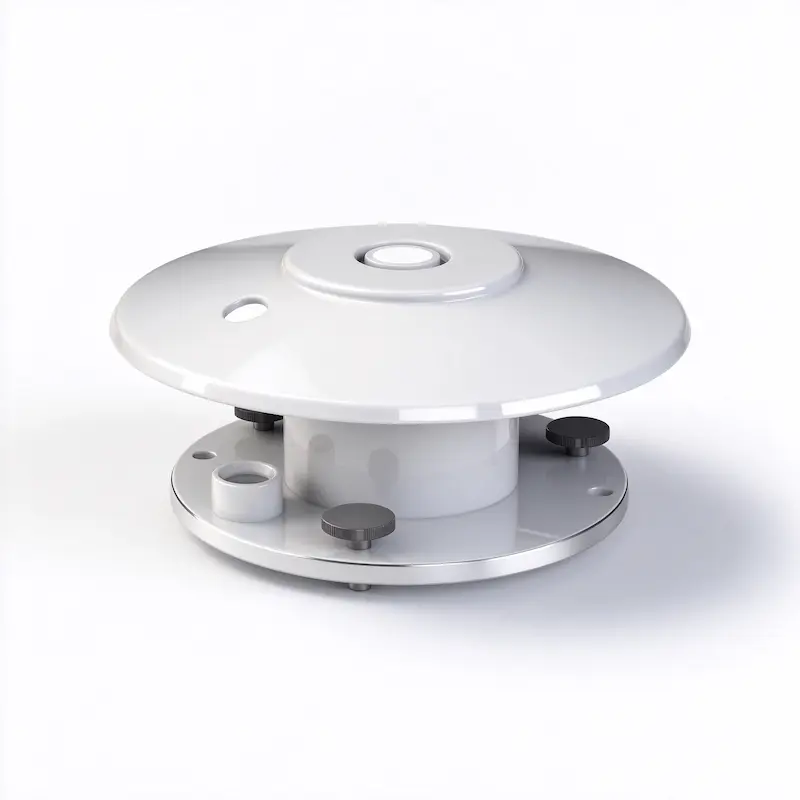
| Specification Parameter | Technical Details |
|---|---|
| Model / Series | CC-S14 Pyranometer (CC-S Series) |
| ISO 9060 / WMO Classification | Class C (ISO 9060:2018) |
| Measurement Principle | Silicon Photodiode (Photoelectric Principle) with Cosine Diffuser |
| Radiometric & Optical Performance Specifications | |
| Measuring Range | 0 to 2000 W/m² |
| Spectral Range | 300 to 1100 nm |
| Accuracy | < ±5% (Typical ±3%) |
| Resolution | 1 W/m² |
| Sensitivity | 7 to 14 µV/(W·m⁻²) (For 0–20 mV analog output version) |
| Response Time (95%) | 1 s |
| Non-stability (Annual Drift) | < 2% per year |
| Cosine Response | ±4% (at 75° zenith angle) | ±1% (at 45° zenith angle) |
| Temperature Response | < 1% (5°C to 40°C) |
| Calibration & Recalibration Cycle | Calibrated under natural solar spectrum | Recommended 2-year recalibration cycle |
| Electrical, Communication & Mechanical Configurations | |
| Output Signal Options | • Digital Interface: RS485 (Modbus-RTU, 9600 bps, 8-N-1, min. 500 ms polling interval) • Passive Analog: 0 to 20 mV |
| Measured & Calculated Data | • Real-time Solar Irradiance: W/m² • Daily Cumulative Irradiation: MJ (2 decimal places, Register Value / 100) • Monthly & Annual Cumulative Irradiation: MJ (Supports remote zero-reset via Modbus) |
| Power Supply | Passive (No power required for mV output) | 12 VDC (For RS485 version) |
| Operating Environment | Temperature: -40°C to +55°C | Humidity: ≤ 100% RH |
| Construction & Leveling | Integrated Sun Shield | Built-in Bubble Spirit Level with Top Viewing Hole | Levelling Bolts |
| Dimensions & Weight | Sun Shield Diameter: Ø170 mm | Base Diameter: Ø137 mm | Overall Height: 55.5 mm | Mounting Holes: 2 × Ø8 mm (120 mm pitch) | Weight: 260 g (excluding cable) |
| Cable Length | 2 m standard shielded cable; custom lengths available upon request) |
| Tailored OEM/ODM Capability | • Brand Customization: Custom silk-screen or laser-engraved logo branding available. • Packaging Options: Private-label custom protective packaging and calibration certificates. • Technical Adaptation: Customizable cable lengths and output configurations. |
| Applications | Solar radiation observation, smart agriculture & greenhouse monitoring, meteorological stations, and hydrological research. |
CC‑S14 Pyranometer: ISO 9060 Class‑C Silicon Photodiode Solar Irradiance Sensor
Meta Title: CC‑S14 Class‑C Pyranometer | Silicon Photodiode Solar Irradiance Sensor
Meta Description: Chaosensor CC‑S14 ISO 9060 Class‑C pyranometer with silicon photodiode detector. Fast‑response solar irradiance sensor for small‑scale PV, smart agriculture and agrometeorological monitoring.
Overview of the CC‑S14 Pyranometer
The Chaosensor CC‑S14 Pyranometer is an ISO 9060:2018 Class‑C pyranometer built around a filtered silicon photodiode, designed to measure global solar irradiance across a 0–2000 W/m² range. This CC‑S14 Pyranometer features a compact housing, quick response and flexible output options, making it a budget‑friendly choice for distributed photovoltaic monitoring, greenhouse microclimate control, agrometeorological stations and ecological field sampling. If your project calls for higher spectrally flat accuracy than the CC‑S14 Pyranometer can deliver, compare our CC‑S13 Class‑A Pyranometer and our mid‑range CC‑S05 Thermopile Pyranometer, an ISO 9060 spectrally flat Class‑B thermopile pyranometer for broadband solar radiation capture.
Working Principle of the CC‑S14 Pyranometer
The CC‑S14 Pyranometer converts incoming sunlight into measurable electrical signals using a precision silicon photodiode paired with a cosine diffuser. Its spectral response covers 300–1100 nm, closely matching the response of standard silicon PV cells. Unlike thermopile radiometers, the CC‑S14 Pyranometer offers near instant readings and avoids slow thermal settling. Keep in mind that the CC‑S14 Pyranometer is spectrally selective; for true full‑spectrum 280–3000 nm measurements, upgrade to the Class‑B CC‑S05 or Class‑A CC‑S13 thermopile pyranometers instead.
Key Technical Features of the CC‑S14 Pyranometer
- ISO 9060:2018 Class‑C Classification: The CC‑S14 Pyranometer delivers reliable irradiance readings from 0 to 2000 W/m², with typical clear‑sky accuracy around ±3% and overall accuracy better than ±5%.
- Fast Response: ≤ 1 second to reach 95% of the final reading, so the CC‑S14 Pyranometer tracks rapid irradiance shifts caused by moving clouds.
- Low Long‑Term Drift: Annual non‑stability under 2%, factory calibrated; we recommend recalibrating the CC‑S14 Pyranometer every two years.
- Two Output Options: Passive 0–20 mV analog output or optional RS485 Modbus‑RTU digital output for direct integration with data loggers and SCADA systems.
- Built‑in Bubble Level: Helps installers level the CC‑S14 Pyranometer correctly to minimise cosine and tilt error.
- Robust Outdoor Housing: Rated for −40°C to +55°C and up to 100% RH, suitable for year‑round unattended outdoor deployment.
- Customisable: Custom cable lengths, OEM branding and private labelling are available for system integrators ordering the CC‑S14 Pyranometer in bulk.
Typical Applications for the CC‑S14 Pyranometer
1. Distributed and Rooftop PV Monitoring
The CC‑S14 Pyranometer is widely used on rooftop solar arrays, commercial PV systems and small ground‑mount plants. It provides continuous irradiance data to calculate performance ratio and flag generation anomalies. For bankable third‑party PV acceptance, select either the Class‑B CC‑S05 or premium Class‑A CC‑S13 rather than the CC‑S14 Pyranometer.
2. Smart Greenhouse and Precision Agriculture
Growers deploy the CC‑S14 Pyranometer to quantify incoming solar radiation, drive evapotranspiration models and automate shade curtains or supplemental lighting. Real‑time data from the CC‑S14 Pyranometer helps optimise light levels for vegetables, berries, ornamental crops and hydroponic systems.
3. Agrometeorology and Ecological Monitoring
Because of its competitive price point, the CC‑S14 Pyranometer works well for dense sensor networks across farmland, wetlands and catchment areas, where many measurement nodes are needed for spatial radiation mapping.
Product Selection: CC‑S14 Pyranometer vs Thermopile Pyranometers
When choosing a solar radiation sensor, the CC‑S14 Pyranometer fills the cost‑effective entry‑to‑mid spot for trend monitoring. If you need higher‑grade thermopile technology:
- Choose the CC‑S14 Pyranometer for multi‑point monitoring, small PV sites, agricultural stations and projects prioritising lower hardware cost.
- Choose the CC‑S05 Thermopile Pyranometer: ISO 9060 spectrally flat Class‑B thermopile pyranometer for meteorological stations, medium solar farms and standard solar resource assessment.
- Choose the CC‑S13 Class‑A Pyranometer: reference‑grade Class‑A thermopile pyranometer for bankable PV acceptance and official meteorological observation.
Installation and Maintenance for the CC‑S14 Pyranometer
To get consistent readings from your CC‑S14 Pyranometer, follow these simple rules:
- Use the integrated bubble level to mount the CC‑S14 Pyranometer perfectly horizontal.
- Position the CC‑S14 Pyranometer with an unobstructed hemispherical sky view, free from shadows by poles, buildings or vegetation.
- Protect cable junctions from UV and mechanical strain.
- Gently clean the diffuser of the CC‑S14 Pyranometer regularly to remove dust, pollen and bird droppings.
- Schedule recalibration every two years to preserve the accuracy of the CC‑S14 Pyranometer.
Conclusion
The CC‑S14 Pyranometer is a practical, affordable Class‑C silicon photodiode pyranometer for global solar irradiance logging. The CC‑S14 Pyranometer balances speed, durability and cost for distributed PV, smart agriculture and agrometeorological sensor networks. If your project requires spectrally flat thermopile performance, compare our CC‑S05 Class‑B pyranometer and CC‑S13 Class‑A pyranometer. Reach out to our technical team for datasheets, wiring diagrams, calibration certificates and bulk pricing for the CC‑S14 Pyranometer.
FAQ
What makes the CC‑S14 Pyranometer different from CC‑S05 and CC‑S13?
The CC‑S14 Pyranometer is a Class‑C silicon photodiode pyranometer best suited for trend monitoring. The CC‑S05 is a spectrally flat Class‑B thermopile pyranometer, while the CC‑S13 is our highest‑grade Class‑A thermopile pyranometer for bankable PV and reference meteorology.
Can I use the CC‑S14 Pyranometer for utility‑scale PV acceptance?
The CC‑S14 Pyranometer is excellent for continuous trend monitoring, but it is not recommended for formal bankable acceptance. For IEC 61724‑1 compliance, use either the Class‑B CC‑S05 or Class‑A CC‑S13 pyranometer instead of the CC‑S14 Pyranometer.
Does the CC‑S14 Pyranometer support Modbus‑RTU?
Yes, the CC‑S14 Pyranometer offers optional RS485 Modbus‑RTU digital output alongside the passive analog output, returning real‑time irradiance and cumulative irradiation values.