
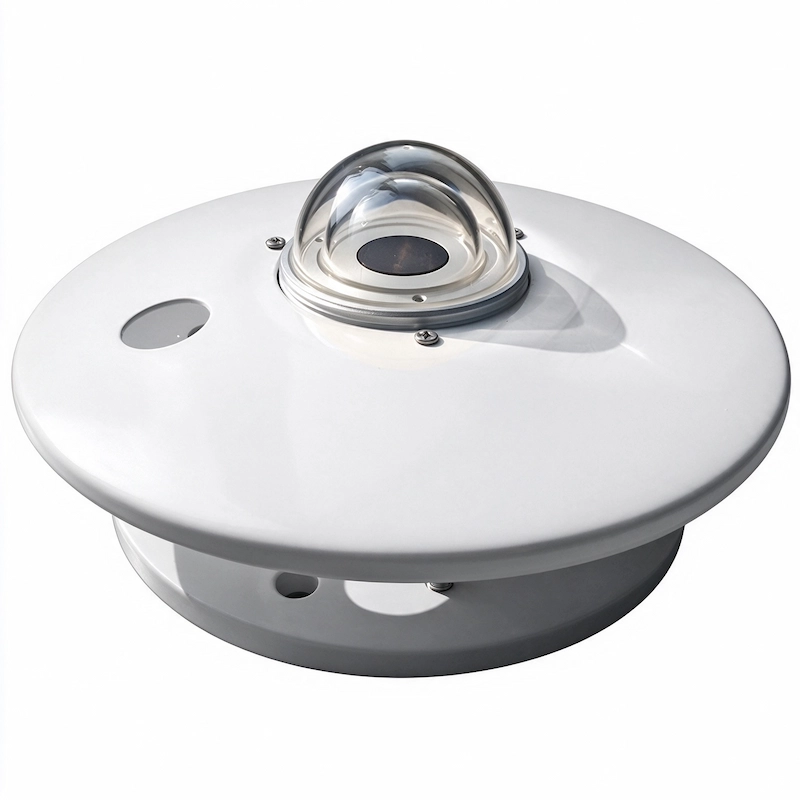
| Specification Parameter | Technical Details |
|---|---|
| Model | CC-S03 Pyranometer (Solar Irradiance Sensor) |
| Key Measurements | Solar Irradiance |
| Measurement Range | 0 – 2000 W/m² |
| Spectral Range | 0.3 – 3 μm (Broadband Solar Spectrum) |
| Response Time | ≤35 seconds (95% response propagation) |
| Cosine Response | ≤7% (Zenith angle directional response limits) |
| Azimuth Error | ≤5% |
| Nonlinearity | ≤2% |
| Temperature Characteristics | ±2% (-40°C to +80°C thermal stability adjustment) |
| Optical Specification | Double-layer quartz glass dome designed to block outer shield infrared (IR) radiation |
| Structural Feature | Built-in internal air convection damper and user-replaceable desiccant dryer cartridges |
| Output Signal | RS485 (Modbus-RTU) / 4 – 20 mA / 0 – 5 V / 0 – 2.5 V |
| Power Supply | 12 – 24 VDC (Std.) / 3.3 / 5 VDC (Opt.) |
| Cable Length | Fully customizable configurations available upon request (Optional) |
| Tailored OEM/ODM Capability | Custom silk-screen or laser-engraved corporate logo branding, tailor-made physical parameters, altered output signals, and private-label colored packaging designs. |
| Industrial Applications | Utility-scale solar energy infrastructure, distributed PV power monitoring, agritech telemetry integration, professional weather stations, scientific climate research, and smart environmental tracking matrices. |
1. Scientific Overview
The CC-S03 Pyranometer (Solar Irradiance Sensor) is a precision instrument built to capture reliable global horizontal solar readings for solar and meteorological projects. This pyranometer works across a broadband spectrum, capturing both direct sunlight and diffuse sky radiation, which makes it essential when you need trustworthy solar data for photovoltaic performance evaluation and climate observation. If you are building a solar monitoring system or an automatic weather station, choosing a well-calibrated pyranometer is the foundation of accurate data.
Many system integrators prefer this unit because it supports multiple output options. Whether your control system uses analog current or voltage signals, or you rely on digital Modbus communication, the device can fit your design. You can pair it with other environmental sensors from our lineup, including our CC-M70 ultrasonic wind speed and direction sensors, temperature and humidity transmitters, and rain sensors, to build a complete weather monitoring station for solar farms or research sites. Good monitoring stations often follow measurement guidance published by the World Meteorological Organization.
2. Optical and Mechanical Advantages
A high-quality pyranometer depends heavily on its optical dome. This model uses a dual quartz dome to reduce thermal offset and limit infrared interference, a common issue that can skew readings for cheaper alternatives. Thanks to this design, it maintains good cosine and azimuth response even when the sun sits at low angles in the sky.
Moisture is another major enemy of outdoor radiometers. That is why this sensor includes a convection damping structure plus replaceable desiccant. These features stop condensation inside the housing, keeping the optical path clean and preserving calibration for longer. With an IP67 rated enclosure, it can run reliably through heat, frost, dust and coastal salt spray, suitable for long-term unattended field deployment.
3. Typical Deployment Scenarios
This pyranometer is widely used wherever reliable solar measurement is required:
- Large PV Power Plants: It provides reference data to calculate plant performance ratio and identify abnormal power output.
- Meteorological Stations: Researchers use it to collect long-term solar radiation records for climate modelling.
- Agricultural Monitoring: Growers rely on its readings to estimate crop photosynthesis and evapotranspiration.
- Renewable Energy Assessment: Engineers use it during site surveys to estimate how much energy a planned solar installation can produce.
- Smart City and Environmental Research: It helps track urban microclimate and support renewable energy forecasting.
4. Installation and Maintenance Tips
Even the best radiometer will not perform well if installed incorrectly. Mount it perfectly level, and keep the dome clear of shadows from poles, buildings or trees. Regular cleaning of the quartz dome is also required; dust and dirt on the surface will lower the measured value and make the data unreliable. Simple periodic care will help your device stay accurate for many years.
5. Frequently Asked Questions
What is the difference between solar irradiance and solar irradiation?
Solar irradiance is instantaneous power per square metre, measured in W/m², which this pyranometer captures directly. Solar irradiation is the total accumulated energy over time, calculated from continuous sensor readings. Relevant terminology standards can be found in documents from ISO.
Can I get a custom version?
Yes. We offer OEM and ODM service. You can request custom cable lengths, adjusted output settings, and branding options to match your project requirements.
Is this pyranometer suitable for scientific-grade monitoring?
Absolutely. It is built for stable long-term outdoor measurement. Its thermal design, dual dome optics and moisture protection make it a solid pick for professional solar and meteorological monitoring projects.