
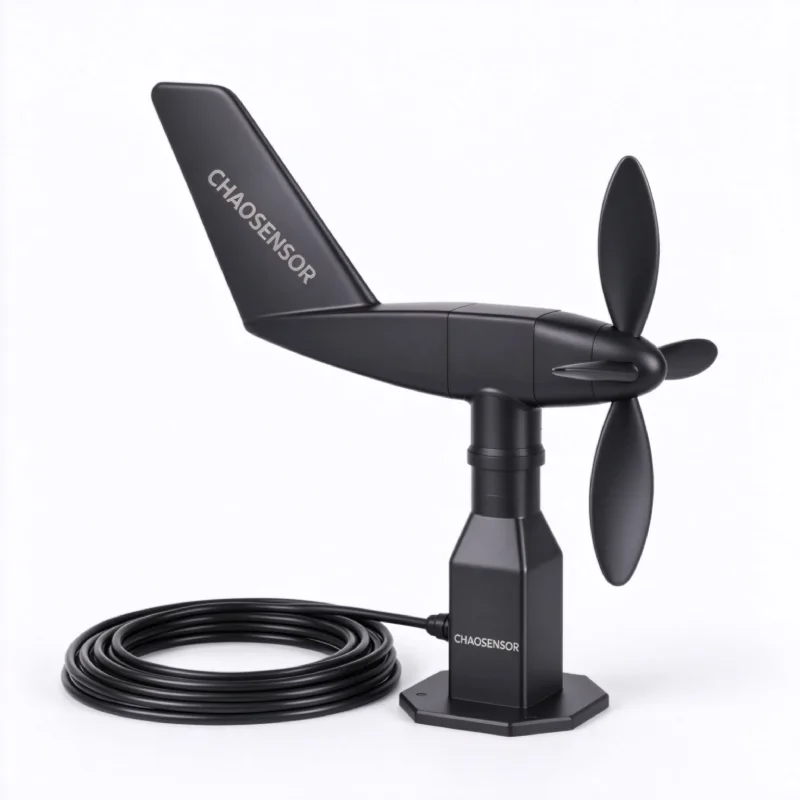
| Specification Parameter | Technical Details |
|---|---|
| Model / Series | CC-M-PROP4P 4-Blade Propeller-Vane Wind Speed & Direction Sensor (CC-M Series) |
| Key Measurements Matrix | Horizontal Wind Speed, Wind Direction (0°–360° Full Circle) |
| Sensing Principle | Non-contact Magnetic Induction (Zero Mechanical Wear & Long Service Life) |
| Wind Speed Performance Specifications | |
| Wind Speed Measurement Range | 1.0 – 90 m/s |
| Wind Speed Accuracy | ±0.5 m/s (Full Scale) |
| Wind Speed Resolution | 0.1 m/s |
| Wind Speed Starting Threshold | < 1.1 m/s |
| Wind Direction Performance Specifications | |
| Wind Direction Measurement Range | 0° – 360° (Full Circle, No Dead Band) |
| Wind Direction Accuracy | Better than ±1° |
| Wind Direction Resolution | 0.5° |
| Wind Direction Starting Threshold | < 1.0 m/s |
| Mechanical & Environmental Durability | |
| Structural Wind Resistance | Up to 100 m/s (Survival Gust Rating) |
| Rotor & Vane Design | Aerodynamic 4-Blade Helicoid Propeller with High-Sensitivity Streamlined Tail Vane |
| Housing & Bearing Material | Anodized Marine-Grade Aluminum Alloy Housing (Anti-Corrosion Coated); Sealed Precision Stainless Steel Bearings |
| Operating Environment | Temperature: -40°C to +70°C | Humidity: 0 – 100% RH | Salt-Fog & Icing Resistant |
| Ingress Protection | IP65 (Dust-tight & Water-Jet / Heavy Rain Resistant) |
| System & Hardware Configurations | |
| Output Signal & Protocols | RS485 serial interface (Supports NMEA-0183 & Modbus-RTU protocols) |
| Power Supply & Consumption | 12 – 24 VDC (Wide Voltage Input) | Operating Current: 80 mA @ 12 VDC |
| Connector & Cable | Waterproof Aviation Connector (4-Pin) | Cable length fully customizable upon request |
| Mounting Interface | Standard 4-Hole Flange Base (Compatible with marine masts and meteorological towers) |
| Tailored OEM/ODM Capability | • Brand Customization: Custom silk-screen or laser-engraved logo branding available. • Packaging Options: Private-label custom colored packaging designs. • Technical Adaptation: Fully customizable sensing ranges, output signal configurations (4–20mA / 0–5V / Pulse optional), and cable lengths. |
| Applications | Heavy-duty wind monitoring across marine vessels, offshore platforms, coastal ports, automatic weather stations (AWS), wind turbine nacelles, bridges, construction tower cranes, and intelligent agrometeorological telemetry. |
Product Overview
The CHAOSENSOR CC‑M‑PROP4P Propeller‑Vane Wind Speed & Direction Sensor is a heavy‑duty professional‑grade propeller‑vane anemometer engineered for high‑accuracy horizontal wind measurement in demanding marine, coastal, industrial and meteorological environments. Adopting aerodynamic four‑blade helicoid propeller paired with streamlined tail vane and non‑contact magnetic induction sensing principle, this sensor delivers stable wind speed and full‑circle 0°‑360° wind‑direction data without mechanical brush wear. Built with marine‑grade anti‑corrosion materials and sealed precision stainless‑steel bearings, it survives extreme gusts up to 100 m/s, making it well‑suited for offshore platforms, port facilities, bridge safety monitoring and WMO‑compliant automatic weather stations. If you are evaluating alternative mechanical wind sensor solutions, please review our CHAOSENSOR CC‑M15‑A Combined Wind Speed and Direction Sensor. For moving‑part‑free solid‑state wind monitoring, explore our CHAOSENSOR CC‑M70 Ultrasonic Wind Speed & Direction Sensor.
Core Working Principle
The CC‑M‑PROP4P propeller‑vane anemometer consists of two independent sensing assemblies: four‑blade helicoid propeller for wind‑speed acquisition and balanced streamlined tail vane for wind‑direction alignment.
- Wind Speed Measurement: Oncoming wind spins the four‑blade helicoid propeller. Non‑contact magnetic‑induction module captures rotational frequency; rotation speed is proportional to real‑time wind speed. No brushes or slip‑rings eliminate contact‑wear failure points.
- Wind Direction Measurement: The streamlined tail vane automatically orients the whole instrument assembly facing into incoming wind. Magnetic‑induction encoder outputs real‑time azimuth value covering full 0°‑360° without dead‑zone.
- Signal Output: Internal processing unit converts rotation and azimuth signals into standard digital protocol data for host data‑logger or SCADA system.
Key Features & Engineering Advantages
- Heavy‑Duty Marine‑Grade Construction: Anodized marine‑grade aluminum‑alloy housing with anti‑corrosion coating, paired with sealed precision stainless‑steel bearings; excellent salt‑fog, UV and icing resistance for coastal and offshore deployment.
- High‑Performance Wind Metrics: Wind‑speed measuring range 1.0‑90 m/s, survival gust rating up to 100 m/s; wind‑direction full 0‑360° coverage with ±1° high accuracy, low starting threshold below 1.1 m/s for light‑wind capture.
- Non‑Contact Magnetic Induction Sensing: Brush‑free magnetic‑induction design removes mechanical contact‑wear points, greatly extending service‑life compared with traditional contact‑type potentiometer‑based propeller‑vane sensors.
- WMO‑Compatible Digital Interface: Industrial‑grade RS485 serial output supports Modbus‑RTU and NMEA‑0183 protocols; 12‑24 VDC wide‑voltage power input, easy integration with AWS, PLC, RTU and industrial IoT gateways.
- Rugged Mechanical Mounting: Standard four‑hole flange‑base mounting interface, compatible with marine masts and meteorological observation towers; IP65 ingress‑protection against dust and high‑pressure water‑jet splashes.
- Flexible OEM / ODM Customization: Support laser‑engraved branding, private‑label packaging, customized cable‑lengths and optional 4‑20 mA / 0‑5 V analog signal conversion for legacy industrial systems.
Sensor Selection Guide: Propeller‑Vane vs Cup‑Vane vs Ultrasonic Anemometer
Each wind‑sensor architecture carries distinct strengths for different project environmental and budget requirements. Compare the CHAOSENSOR CC‑M‑PROP4P against our other mainstream wind‑monitoring products:
- CHAOSENSOR CC‑M‑PROP4P Propeller‑Vane: Best‑fit for marine vessels, offshore platforms, port and heavy‑gust industrial sites. Helicoid propeller‑vane delivers good dynamic wind‑response for turbulent coastal wind‑fields; non‑contact magnetic‑induction minimizes wear; requires periodic visual cleaning of propeller‑vane assembly for salt‑spray sites.
- CHAOSENSOR CC‑M15‑A Combined Wind Speed and Direction Sensor: Classic three‑cup and wind‑vane mechanical anemometer, cost‑effective for general‑purpose weather‑stations, solar‑PV farms and highway meteorology. Optional zirconia ceramic‑bearing upgrade extends lifetime for moderately corrosive outdoor locations.
- CHAOSENSOR CC‑M70 Ultrasonic Wind Speed & Direction Sensor: Zero‑moving‑parts solid‑state ultrasonic solution, maintenance‑friendly for remote unattended stations; built‑in anti‑ice heating for cold‑climate projects; susceptible to signal interference from heavy precipitation and heavy insect‑nest contamination on transducer surfaces.
Choose CC‑M‑PROP4P when your project faces offshore‑marine salt‑fog environment, high‑gust turbulent‑wind conditions, and you require WMO‑quality mechanical‑anemometer performance with long service‑life.
Typical Industrial Applications
- Marine & Off‑shore Facilities: Wind monitoring for seagoing vessels, offshore oil‑gas platforms, coastal port terminals and dock safety alert systems.
- Meteorological Observation Networks & AWS: Core wind‑measuring component for WMO‑compliant automatic‑weather‑stations for coastal regional meteorology.
- Wind‑Turbine Nacelle‑Mounted Monitoring: Provides incoming‑wind data reference for wind‑turbine control logic and extreme‑gust safety protection.
- Bridge & Large‑Structure Safety Monitoring: Cross‑wind early‑warning for long‑span bridges, viaducts and tower‑crane construction‑site risk‑assessment.
- Coastal Agrometeorological Telemetry: Wind‑speed and direction logging for coastal‑zone smart‑agriculture, crop‑protection and micro‑climate research.
Installation & Maintenance Guidelines
To preserve full‑spec measurement accuracy for the CHAOSENSOR CC‑M‑PROP4P Propeller‑Vane Wind Speed & Direction Sensor, follow field‑deployment best‑practices:
- Open‑Site Mounting: Install on meteorological mast with sufficient height, keep clear of buildings, trees and large metal obstructions that will distort natural wind‑flow.
- Mechanical Mount: Fasten securely via standard four‑hole flange‑base; ensure mounting bracket is rigid to avoid excessive vibration under strong‑gust conditions.
- Cable & Power: Use shielded waterproof aviation‑connector; strictly follow wiring specification for 12‑24 VDC power‑supply and RS485 communication wiring.
- Routine Maintenance: For marine / coastal salt‑spray sites, perform periodic visual inspection. Gently clean salt‑deposit, dust and bird‑droppings on four‑blade propeller and tail‑vane surface to guarantee rotation flexibility. Check fastener tightness at regular intervals.
- Surge‑Protection Recommendation: Deploy external lightning and surge‑protection devices for lightning‑prone outdoor observation sites, to protect sensor and backend data‑acquisition hardware.
Frequently Asked Questions (FAQ)
1. What are the main advantages of propeller‑vane anemometer compared with cup‑vane mechanical wind‑sensor?
Propeller‑vane design represented by CHAOSENSOR CC‑M‑PROP4P features helicoid propeller paired with tail‑vane that actively faces into incoming wind, delivering superior dynamic‑response performance under turbulent and gusty wind‑fields typical of marine‑coastal locations. The non‑contact magnetic‑induction sensing eliminates brush‑wear failure risk compared with traditional potentiometer‑type propeller‑vane units. Our CHAOSENSOR CC‑M15‑A Combined Wind Speed and Direction Sensor (cup‑vane type) is more cost‑effective for general‑land‑based meteorological‑monitoring scenarios.
2. Can CC‑M‑PROP4P work for offshore salt‑fog corrosive environments?
Yes. The CC‑M‑PROP4P uses marine‑grade anodized aluminum‑alloy housing plus sealed stainless‑steel bearings with salt‑fog‑resistant treatment. It is purpose‑built for coastal‑port and offshore‑platform deployment; regular surface cleaning of propeller‑vane assembly is still required to prevent salt‑crystal accumulation.
3. Should I pick propeller‑vane mechanical sensor or CHAOSENSOR CC‑M70 Ultrasonic Wind Speed & Direction Sensor?
Select CC‑M‑PROP4P if you prioritize proven WMO‑recognized mechanical‑anemometer dynamic‑wind‑response performance for marine‑coastal turbulent‑wind environment and accept scheduled visual mechanical‑component maintenance. Choose CC‑M70 ultrasonic wind‑sensor for remote hard‑to‑access stations where zero‑moving‑parts and low‑maintenance is your top priority.
4. What communication protocols does CC‑M‑PROP4P support?
Standard RS485 hardware supports both Modbus‑RTU and NMEA‑0183 protocols, compatible with most industrial data‑loggers, PLC and meteorological‑station controllers. Analog‑signal output can be customized as OEM option for legacy‑system integration.
5. Do you provide OEM / ODM custom service for CC‑M‑PROP4P?
Yes. CHAOSENSOR supports custom laser‑engraved logo marking, private‑label packaging, customizable cable‑length and tailored signal‑output configuration for project‑level bulk‑order requirements.