
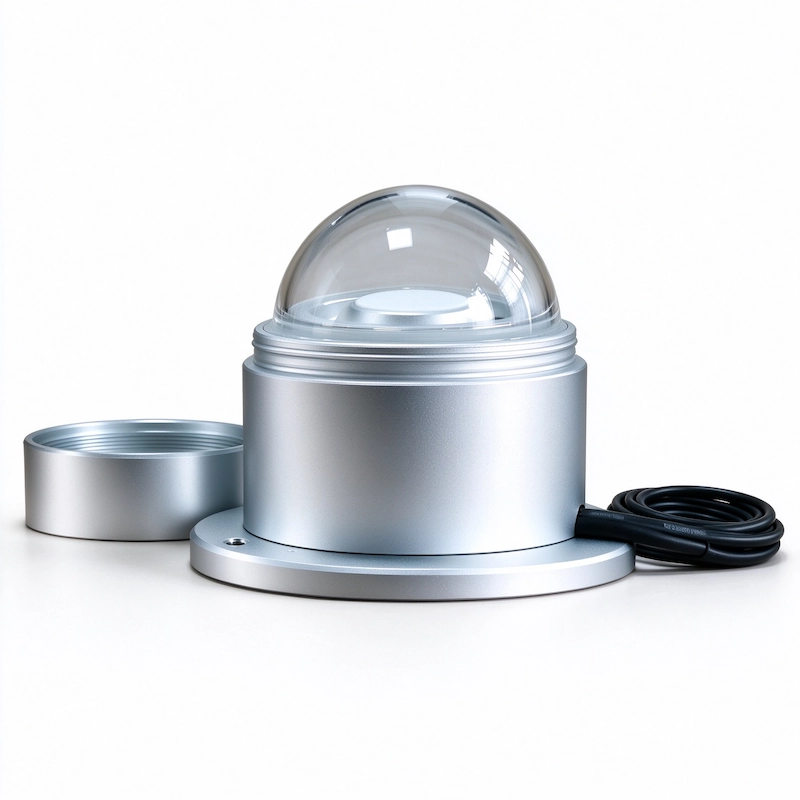
CC‑S01 Pyranometer (Solar Irradiance Sensor)
| Specification Parameter | Technical Details |
|---|---|
| Model | CC‑S01 Pyranometer (Solar Irradiance Sensor) |
| Spectral Range | 300 to 1100 nm (0.3 to 1.1 μm) |
| Measurement Range | 0 to 1500 W/m² (Optional: 0 to 2000 W/m²) |
| Resolution | 1 W/m² |
| Measurement Accuracy Limit | ±5% |
| Output Signal | RS-485 Modbus RTU / 4 – 20 mA / 0 – 5 V / 0 – 2.5 V / 0 – 20 mA |
| Sensitivity Range | 7 to 14 μV/(W·m⁻²) |
| Response Time | < 5 seconds (99% signal step change) |
| Cosine Response | < ±10% (At a low 10° solar altitude angle) |
| Non-Linearity Error | < ±5% |
| Annual Drift Rate | < ±5% |
| Ambient Operational Range | Temperature: -40 to +60 °C | Humidity: ≤ 100%RH |
| Instrument Power Consumption | ≤ 0.48 W |
| Power Supply | 5 VDC / 12 VDC / 24 VDC |
| Cable Length Options | Standard 2.5 m heavy‑duty cable (Custom ultra‑low‑noise shielding extensions available on request) |
CC‑S01 Pyranometer (Solar Irradiance Sensor) for GHI Measurement
The CC‑S01 Pyranometer (Solar Irradiance Sensor) captures total global horizontal irradiance, the core metric used to assess PV output, diagnose generation anomalies and carry out long-term solar resource assessment. Its spectral response from 300–1100 nm closely matches the response of mainstream silicon photovoltaic cells, making this pyranometer a popular pick for distributed and utility-scale solar farms. If you require ultra-fast capture of rapid cloud-driven light fluctuations, compare it with our CC‑S02 fast response pyranometer. When solar plant yield drops unexpectedly, reliable readings from this solar irradiance sensor help engineers tell genuine hardware faults apart from natural sunlight variation.
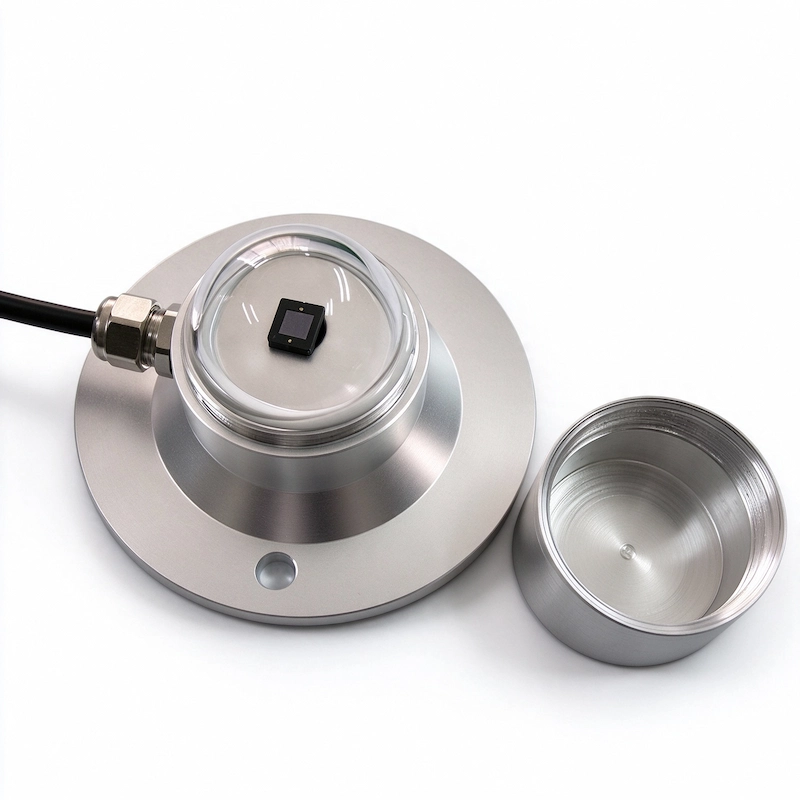
A rich set of output interfaces simplifies integration with existing data acquisition hardware. RS‑485 Modbus RTU supports multi‑sensor bus networking, ideal for large sites with dozens of monitoring nodes. Analog choices including 4‑20 mA, 0‑5 V, 0‑2.5 V and 0‑20 mA maintain compatibility with older loggers without digital bus ports. Built for years of unattended outdoor deployment, the CC‑S01 Pyranometer resists wide temperature swings, high humidity, UV exposure and heavy rainfall. Pair this solar irradiance sensor with our wind speed and direction sensors, temperature‑humidity probes and radiation shields to assemble a full meteorological monitoring station for solar assets.
Typical Applications for the CC‑S01 Pyranometer
- Utility and distributed photovoltaic plant O&M, performance ratio tracking and yield monitoring
- WMO-aligned automatic weather stations run by meteorological agencies and environmental observation networks
- Solar energy research labs for solar resource statistics and experimental validation
- Precision smart agriculture, recording microclimate irradiance to analyse crop photosynthesis
- Smart city environmental stations for urban solar potential and heat-island research
Field Installation & Maintenance for This Solar Irradiance Sensor
- Mount the CC‑S01 Pyranometer perfectly horizontal; remove any surrounding obstacles such as poles, buildings and trees that may cast shade over the optical dome during daylight hours.
- Clean the dome regularly to remove dust, snow, bird droppings and grime. Contamination will suppress irradiance readings and introduce consistent measurement bias.
- Choose RS‑485 Modbus RTU for multi‑sensor networking to cut wiring labour across multi‑point monitoring projects.
- Select analog outputs for legacy acquisition hardware without digital bus support, and match the receiving terminal’s input range carefully.
- Use custom low-noise shielded extension cables for long-distance runs, to reduce electromagnetic interference from inverters and nearby power lines.
- Pick the correct supply voltage from 5 VDC, 12 VDC or 24 VDC to suit site power, and keep supply ripple low for stable measurements.
Frequently Asked Questions
What does the CC‑S01 Pyranometer measure?
The CC‑S01 Pyranometer (Solar Irradiance Sensor) measures global horizontal solar irradiance, reported in W/m². It captures the sum of direct beam radiation plus diffuse sky radiation following standard observation guidance published by ISO.
When should I choose CC‑S01 instead of CC‑S02?
Select the CC‑S01 Pyranometer if you need a stable, cost-effective solar irradiance sensor for routine long-term monitoring, where a 5‑second response speed meets your project requirements. The CC‑S02 fast response pyranometer is better suited for high-frequency research, cloud transient capture and solar forecasting work.