
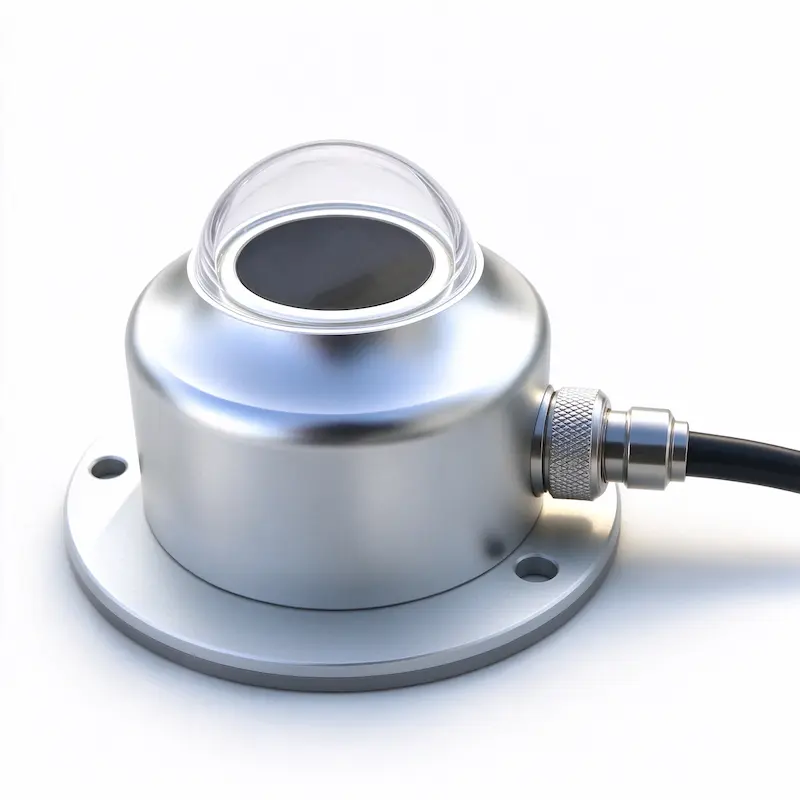
| Specification Parameter | Technical Details |
|---|---|
| Model / Series | CC-S15 Pyranometer / Solar Irradiance Sensor (CC-S Series) |
| ISO 9060 / WMO Classification | Class C (Spectrally Flat, conforms to ISO 9060:2018 & WMO-No. 8 standards) |
| Measurement Principle | Passive Blackened Thermopile with High-Precision Quartz Glass Dome |
| Radiometric & ISO 9060:2018 Performance Specifications | |
| Measuring Range | 0 to 2000 W/m² |
| Spectral Range | 285 to 3000 nm (0.285–3.0 µm) |
| Sensitivity | 7 to 14 µV/(W/m²) (Individual calibration factor supplied on certificate) |
| Response Time (99%) | ≤ 10 s |
| Overall Accuracy | ≤ 5% |
| Non-stability (Annual Drift) | ±2% per year |
| Non-linearity | ±2% |
| Measurement Modes | Global Horizontal Irradiance (Standard) | Reflected Radiation (Inverted) | Diffuse Radiation (With optional shading ring) |
| Calibration Interval | Recommended 2-year recalibration cycle |
| Electrical, Communication & Mechanical Configurations | |
| Output Signal Options | • Passive Analog: 0 to 20 mV (No external power required) • Digital Interface: RS485 (Modbus-RTU, 4800–115200 bps, default 9600 bps, Address 1–255) • Current Loop: 4 to 20 mA (Linearly scaled to 0–2000 W/m² via external converter) |
| Internal Resistance | ≤ 30 Ω (Passive thermopile circuit) |
| Power Supply & Consumption | Passive (No power required for 0–20 mV output) | 6 to 30 VDC, 0.18 W (for RS485 & 4–20 mA versions) |
| Operating Environment | Temperature: -40°C to +80°C | Humidity: 0 to 100% RH |
| Construction & Levelling | Anodized Aluminum Body | Quartz Glass Dome | Integrated Bubble Level & Adjustable Levelling Screws | GX12-4 Aviation Connector |
| Dimensions & Weight | Base Plate Diameter: Ø145 mm | Body Diameter: Ø56 mm | Dome Radius: R17.5 mm | Overall Height: 60.5 mm | Weight: 0.5 kg (excluding cable) |
| Cable Length | 3 m standard shielded cable (Customizable lengths available upon request) |
| Tailored OEM/ODM Capability | • Brand Customization: Custom silk-screen or laser-engraved logo branding available. • Packaging Options: Private-label custom protective packaging and calibration certificates. • Technical Adaptation: Customizable output scaling ranges (e.g., 4–20 mA span), cable lengths, and ventilation/heating hood accessories. |
| Applications | Meteorological observation networks, solar PV power plant monitoring, agricultural & evapotranspiration research, climate observation, and building physics studies. |
CC-S15 Class C Thermopile Pyranometer (Solar Irradiance Sensor) Overview
The CC-S15 Class C Thermopile Pyranometer is an ISO 9060:2018 & WMO-No. 8 compliant Spectrally-Flat Class C thermopile-type pyranometer engineered for reliable global horizontal irradiance (GHI), reflected radiation, and diffuse radiation measurement. Adopting a passive blackened thermopile sensing core protected by a high-precision optical quartz glass dome, it captures true broadband shortwave solar radiation across the 285–3000 nm spectrum. Built with high-precision semiconductor thermopile processing technology, the CC-S15 delivers passive zero-power measurement stability and operates reliably from -40°C to +80°C (0–100% RH) for long-term unattended outdoor deployment. For higher-tier thermopile performance, compare our mid-range ISO 9060:2018 Class-B CC-S05 Thermopile Pyranometer or our reference-grade Class-A CC-S13 Class-A Pyranometer. If your project prioritizes fast-response silicon photodiode sensing over broadband spectral flatness, explore our CC-S14 Pyranometer and CC-S02 Pyranometer (Solar Irradiance Sensor).
Advanced Engineering & Product Benefits
Why choose this Spectrally-Flat Class C thermopile pyranometer for cost-effective meteorological stations, commercial solar PV monitoring, and agrometeorological networks? Our design integrates proven thermopile optics with rugged field-ready hardware:
- Broadband Blackened Thermopile Core: Semiconductor-processed blackened thermopile detector ensures uniform, spectrally-flat sensitivity (7–14 µV/(W/m²)) across 285–3000 nm, eliminating the spectral-selective bias common in silicon-cell sensors.
- High-Precision Optical Quartz Glass Dome: Precision-ground quartz dome optimizes uniform broadband light transmission from 0.285 to 3.0 µm while shielding the internal thermopile core from dust, precipitation, and environmental wear.
- Integrated Precision-Leveling Mechanism: Built-in bubble spirit level paired with M5 hexagonal socket adjustable levelling screws simplifies accurate horizontal alignment on mounting plates, minimizing cosine and tilt-induced measurement deviations.
- Multi-Mode Flexible Industrial Connectivity: Supports passive 0–20 mV analog output (zero power consumption), RS485 Modbus-RTU digital communication (4800–115200 bps), and 4–20 mA current loop via an external signal converter for seamless integration with data loggers, PLCs, and SCADA gateways.
- Compact & Rugged Anodized-Aluminum Housing: Lightweight 0.5 kg sealed metallic enclosure with a GX12-4 aviation connector resists extreme temperatures (-40°C to +80°C), 100% humidity, and harsh outdoor conditions.
Key Industrial Applications
The broadband spectral accuracy, multi-mode mounting flexibility, and universal output options allow this Class C thermopile pyranometer to serve diverse telemetry sectors globally:
- Commercial & Distributed Solar PV Monitoring: Provides reliable plane-of-array (POA) and global horizontal irradiance inputs for Performance Ratio (PR) tracking and yield diagnostics. For a comprehensive PV monitoring suite, pair the CC-S15 with our CC-S08 Back-of-Module Temperature Sensor for cell thermal compensation and our CC-S07 Optical PV Soiling Monitoring System to quantify dust-soiling losses.
- Automatic Meteorological & Synoptic Networks: Delivers WMO-No. 8 compliant shortwave solar radiation data for regional weather stations, climate observation networks, and solar forecasting hubs, working seamlessly alongside our CC-S-ASI All-Sky Imager for automated whole-sky cloud tracking.
- Multi-Component Radiation Observation (Albedometer & Diffuse): When mounted horizontally inverted at ≥1.5 m height, the CC-S15 measures surface albedo (reflected radiation); when fitted with an optional diffraction shading ring, it captures diffuse horizontal irradiance.
- Smart Agriculture & Evapotranspiration Research: Supplies accurate broadband radiation metrics to drive crop evapotranspiration (ET) modeling, greenhouse light automation, and precision irrigation systems.
- Building Physics & Solar Research Platforms: Applied in building energy simulation, urban heat-island studies, and solar collector testing, or integrated onto precision tracking setups with our CC-S10 Automatic Sun Tracker.
Professional On-Site Installation Guide
To preserve Class C measurement accuracy (≤5%) and ensure long-term stability for your CC-S15 pyranometer, field technicians should follow these installation and maintenance protocols:
- Strict Horizontal Leveling & North Orientation: Mount the sensor on a rigid, thermally insulated platform at least 1.5 m above ground with the GX12-4 aviation connector oriented toward true north (in the Northern Hemisphere) to minimize cable shadow interference, then adjust the M5 levelling screws until the bubble level is centered.
- Full Shade-Free Alignment: Select an open site where no surrounding buildings, poles, trees, or structures exceed an elevation angle of 5° at sunrise and sunset, preventing shadows across the quartz dome throughout the year.
- Routine Dome Cleaning & Desiccant Inspection: Remove the white protective cap prior to operation. Regularly clean the outer quartz dome with a soft lint-free cloth or optical lens paper after rain or frost; if internal condensation appears or the blue desiccant turns white, dry at 50–55°C or replace the desiccant promptly.
- Calibration-Cycle Management: Follow the recommended 2-year recalibration cycle to maintain metrological accuracy over multi-year outdoor service.
Technical FAQ Highlights & Irradiance Terminology Clarifications
Understanding key sensor technologies and radiometric terminology helps engineering teams select the ideal pyranometer grade for their monitoring networks:
- How does the CC-S15 Thermopile Pyranometer differ from silicon photodiode models like CC-S14 and CC-S02? Unlike the CC-S14 Pyranometer and CC-S02 Pyranometer—which use silicon photodiodes limited to 300–1100 nm—the CC-S15 uses a blackened thermopile detector covering the full 285–3000 nm solar spectrum without spectral-selective error under cloudy skies. For higher accuracy tiers, compare our Class-B CC-S05 and Class-A CC-S13.
- Can the CC-S15 measure reflected or diffuse solar radiation? Yes. While standard upward horizontal mounting measures global horizontal irradiance (GHI), mounting the CC-S15 horizontally face-down at least 1.5 meters above ground measures reflected solar radiation (albedo), and adding a shading ring enables diffuse radiation measurement.
- What is the difference between Solar Irradiance and Solar Irradiation? Solar Irradiance refers to the instantaneous power of solar radiation per unit area, measured in Watts per square meter (W/m²), which the CC-S15 outputs directly across 0–2000 W/m². Conversely, Solar Irradiation represents total accumulated radiant energy over a given period (such as hourly or daily MJ/m² or kWh/m²), calculated by integrating irradiance over time.